- The short answer: what not to miss
- The Pink City - where the name comes from
- The old city: Hawa Mahal, the City Palace and Jantar Mantar
- Amber Fort and the Sheesh Mahal
- Outside the walls: Albert Hall and Jal Mahal
- The main sights at a glance
- Itinerary: Jaipur in one day and in two
- Bazaars and crafts
- Food in Jaipur
- Practical tips
- Sources
- Frequently asked questions
What to see in Jaipur if you have one or two days? In short: Hawa Mahal, the Palace of Winds; Amber Fort with its Mirror Palace, the Sheesh Mahal; the City Palace of the maharajas; the Jantar Mantar observatory; and the bazaars of the old city.
Jaipur, the capital of Rajasthan, is the third corner of the Golden Triangle. This guide covers the city itself; for the wider region, see Rajasthan: what to see.
The short answer: what not to miss
- Amber Fort - a hilltop palace-fortress 11 km from the centre, with courtyards, a garden and the Mirror Palace. The highlight of Jaipur.
- Hawa Mahal - a pink facade with 953 small windows, the symbol of the city.
- The City Palace - the maharajas' palace, where the royal family still lives.
- Jantar Mantar - an 18th-century observatory with a giant sundial, a UNESCO World Heritage Site.
- The old city bazaars - jewellery, hand-printed textiles and leather slippers.
How many days in Jaipur? Two: one for the old city, one for Amber Fort. One day is possible, but rushed.
The Pink City - where the name comes from
Jaipur was founded in 1727 by Maharaja Sawai Jai Singh II, who moved his capital here from hilly Amber. The new city was laid out on the plain on a grid of broad avenues, as a capital of trade and crafts, which it still is. For this plan and its living merchant traditions, the walled city was inscribed on the UNESCO World Heritage List in 2019.
The pink came later. In 1876, under Sawai Ram Singh II, the city was painted pink to welcome the Prince of Wales. Many old city streets keep the colour today, though it is closer to terracotta than to postcard pink.
The old city: Hawa Mahal, the City Palace and Jantar Mantar
The three main sights of the old city stand side by side, so half a day covers them.
Hawa Mahal - the Palace of Winds
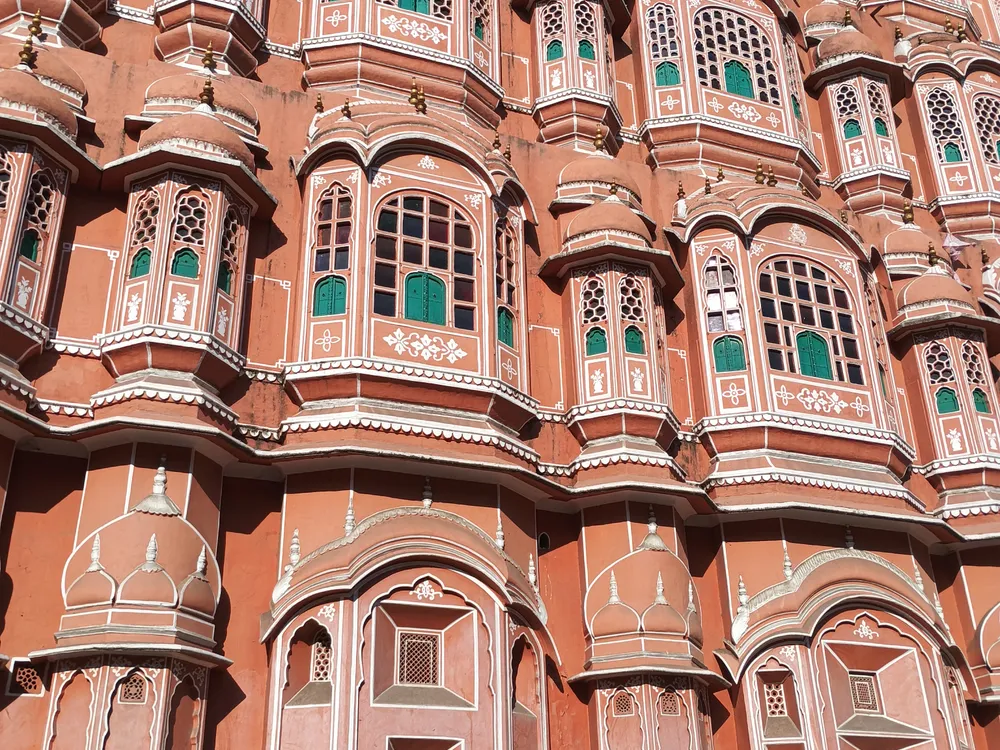
Jaipur's most famous facade was built in 1799 for Maharaja Sawai Pratap Singh, grandson of the city's founder. Its five storeys, about 15 metres high, hold 953 small windows (jharokhas) with carved stone screens, through which the women of the court watched street life unseen. The windows also let the breeze through, hence the name.
From the street you see the back of the palace, not the front. The top floors are reached by ramps, not stairs. For the best photo, stand across the street in the morning, when the sun lights the facade from the east.
The City Palace - home of the maharajas
Completed in 1732, the palace now houses a museum, and part of it is still home to the royal family.
Look for the Pritam Niwas Chowk courtyard with four decorated gates dedicated to the seasons (one is the Peacock Gate), the textile gallery in the Mubarak Mahal, and two huge silver urns called gangajalis. Each is 1.6 metres tall, holds 4,000 litres and weighs 340 kg. Maharaja Sawai Madho Singh II had them made to carry Ganges drinking water to England in 1902, for the coronation of Edward VII.
Jantar Mantar - an open-air observatory
Next to the palace is the observatory built by the same Sawai Jai Singh II, roughly in 1728-1738: some 20 large masonry instruments for observing the sky with the naked eye. UNESCO, which inscribed it in 2010, calls it the best-preserved of India's historic observatories.
The biggest, the Vrihat Samrat Yantra, is 27 metres high and one of the largest sundials in the world. It is said to tell the time to within about two seconds. Without a guide the instruments look like strange sculptures; with one, they come alive.
Amber Fort and the Sheesh Mahal
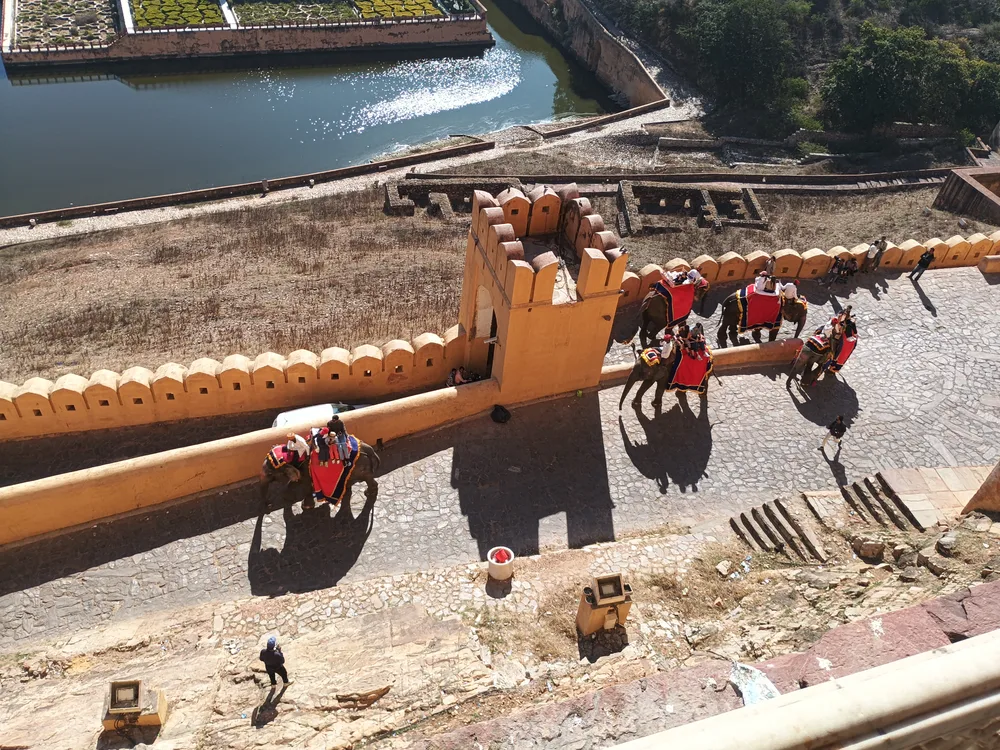
Amber Fort (also spelled Amer) stands 11 km from the centre, on a hill above Maota Lake. It was the capital of the Kachwaha rulers until they moved to Jaipur in 1727. Since 2013 it has been on the UNESCO list as one of the six Hill Forts of Rajasthan.
Getting up to the fort
Visitors ride up the narrow road to the Suraj Pol (Sun Gate) by jeep. You can also walk, or ride an elephant, although the jeep is now considered the more ethical choice. On Colourful India you can choose either.
What to see inside
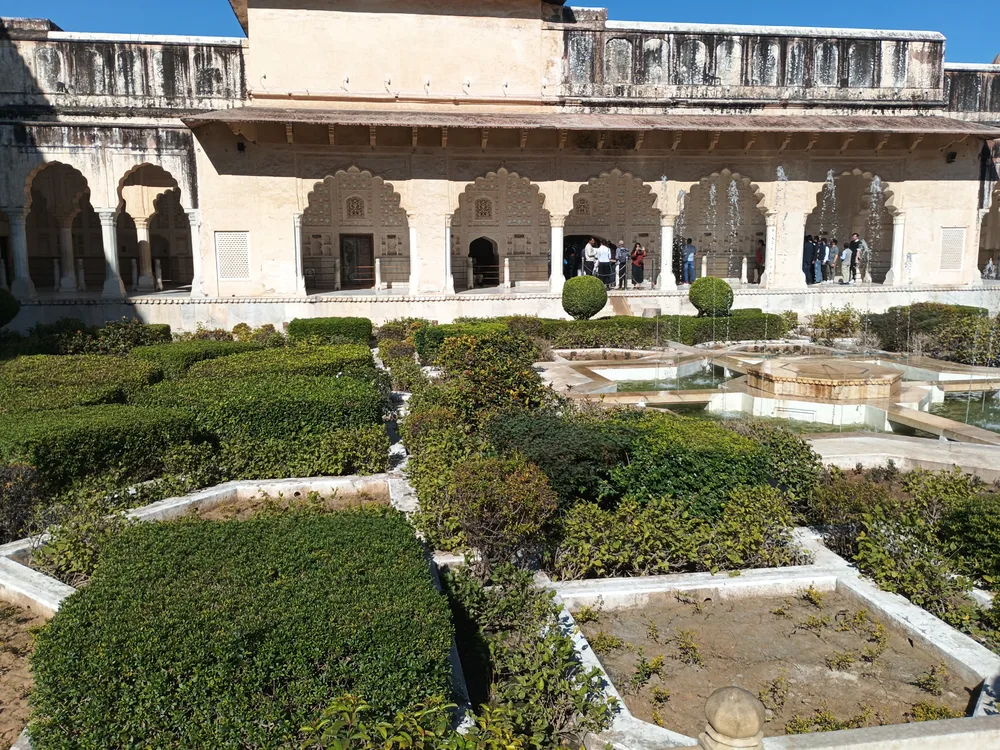
The palace rises over four levels, each with a courtyard, and includes the audience halls Diwan-i-Aam and Diwan-i-Khas. In the third courtyard lies a Mughal-style garden (a charbagh) fed by water channels from the Sukh Niwas.
The highlight is the Sheesh Mahal, the Mirror Palace (also called Jai Mandir). Its walls and ceilings are covered with a mosaic of small convex mirrors and coloured glass. By candlelight the room glittered like a jewel box. Look for the marble "magic flower" panel by one of the pillars: cover parts of it with your hands and it turns into a fish tail, a lotus, a cobra or a scorpion.
Jaigarh and Nahargarh - if you have more time
Above Amber Fort, on the same ridge, stands Jaigarh, linked to it by an underground passage. It holds the Jaivana cannon, cast on site in 1720 and at the time the largest cannon on wheels in the world. Nahargarh, built mainly in 1734, sits on the edge of the hills right above the city, with views over the old town. Both suit a second day.
Jaipur with a tour leader: on Pearls of North India day three covers the City Palace, Jantar Mantar and the Albert Hall Museum, and day four Hawa Mahal, Amber Fort, Jal Mahal and a traditional block-printing workshop, plus a dinner with a dance show in Jaipur. 12 days, from 900 EUR (3-star), expected departure: 10 March 2027.
Send me the itineraryOutside the walls: Albert Hall and Jal Mahal
The Albert Hall Museum
The oldest museum in Rajasthan, opened in 1887 in the Ram Niwas Garden just outside the old city walls. It is named after the Prince of Wales, who laid its foundation stone in 1876. Samuel Swinton Jacob designed the Indo-Saracenic building. Its star exhibit is an Egyptian mummy.
Jal Mahal - the Water Palace
A five-storey sandstone palace in the middle of Man Sagar Lake. It was built around 1699 as a lodge for duck hunting and enlarged in the mid-18th century. When the lake is full, four floors are under water. You see it from the promenade, on the way to the fort.
The main sights at a glance
| Place | What it is | Time needed | Good to know |
|---|---|---|---|
| Amber Fort | palace-fortress, UNESCO (2013) | 2-3 hrs | 11 km from the centre, up by jeep |
| Hawa Mahal | Palace of Winds, 1799 | 30-45 min | facade best in the morning, ramps inside |
| City Palace | royal palace and museum | 1.5-2 hrs | silver urns, Peacock Gate |
| Jantar Mantar | observatory, UNESCO (2010) | 45 min-1 hr | with a guide, on a sunny day |
| Albert Hall Museum | Rajasthan's oldest museum | 1 hr | Egyptian mummy, crafts |
| Jal Mahal | palace in a lake | 15-20 min | seen from the shore, on the way to Amber |
| Jaigarh, Nahargarh | hilltop forts | 1-2 hrs each | for a second day, city views |
| Old city bazaars | jewellery, textiles, slippers | 1-2 hrs | haggle, beware of "bargains" |
Visiting time only, without travel. The old city and Amber Fort are 11 km apart, but traffic makes it feel further.
Itinerary: Jaipur in one day and in two
Two days (recommended). Day one: the City Palace, Jantar Mantar and the Hawa Mahal facade, then the Albert Hall Museum or the bazaars. Day two: Amber Fort early, before the crowds and heat, with a stop at Jal Mahal, then inside Hawa Mahal and a block-printing workshop or Nahargarh.
One day. Amber Fort in the morning with a stop at Jal Mahal, the City Palace and Jantar Mantar after lunch, and Hawa Mahal to finish. The Albert Hall and the bazaars then only from the car window.
On our tours: Pearls of North India and Colourful India spend two days in Jaipur, much like the plan above. On Golden Cities of Rajasthan you arrive from Pushkar on day nine and see the main sights on day ten, before driving to Agra. From Goa you can fly in for India in a Nutshell: Jaipur on day one, then Agra and Delhi (more in side trips from Goa).
Bazaars and crafts
Two bazaars worth knowing: Johari Bazaar is the jewellers' street, with traditional jewellery, including kundan work, and gemstones. Bapu Bazaar is for textiles, leather goods and colourful mojari slippers with curled toes.
The most interesting craft, though, is hand block printing on fabric with carved wooden blocks. Two towns near Jaipur are famous for it: Sanganer, with bright patterns on white backgrounds, and Bagru, with natural dyes and the dabu technique, in which parts of the cloth are protected from the dye with a mud paste. Three of our tours include a workshop where you can watch it.
What to watch out for: Jaipur is a world centre of gem cutting, so the same scam has run for years: a friendly stranger offers stones "at wholesale prices" to resell at a profit back home. Buy jewellery for yourself, never as an "investment". Be wary, too, of shops "recommended" by a driver or tout, because their commission is in the price. More in money in India.
Food in Jaipur
Try dal baati churma (baked wheat dough balls with lentils and a sweet crumble), gatte ki sabzi (gram flour dumplings in a yoghurt curry) and ker sangri, made from desert berries and beans. If you like it hot, order laal maas, a mutton curry with red chilli. For dessert, ghevar, a disc of fried batter soaked in syrup. Eating safely: food in India.
Practical tips
- From Delhi. Jaipur is about 270 km from Delhi. The drive takes several hours, depending on traffic; on our tours it shares a day with the first sightseeing. See also Delhi: what to see.
- On to Agra. On Pearls of North India and India in a Nutshell the drive from Jaipur to Agra includes a stop at Fatehpur Sikri, the abandoned capital of the emperor Akbar. Next: the Taj Mahal: a visiting guide.
- Tickets. Entry to the monuments is paid, and foreign visitors pay more than Indian citizens. Prices change; check at the ticket office. Entrance fees are not included in our tour prices.
- Shoes. Amber Fort means cobbles and steps: wear comfortable shoes.
- Season. October to March is the most pleasant time. From April it gets very hot. More in the best time to visit India.
- Tour leader. The English-speaking tour leader travels in person with groups of at least 10 people. Smaller groups get remote support and round-the-clock help from the Abyss Tours team.
Sources
- UNESCO - Jaipur City, Rajasthan (inscribed 2019, founded 1727, city plan)
- UNESCO - Hill Forts of Rajasthan (inscribed 2013, Amber Fort)
- UNESCO - The Jantar Mantar, Jaipur (inscribed 2010, some 20 instruments)
- Jaipur (Wikipedia) - distance, colour, crafts, food
- Hawa Mahal (Wikipedia) - date, 953 windows, ramps
- Amber Fort (Wikipedia) - Sheesh Mahal, garden, access
- City Palace, Jaipur (Wikipedia) - history, silver urns
- Jantar Mantar, Jaipur (Wikipedia) - construction, Vrihat Samrat Yantra
- Albert Hall Museum (Wikipedia) - architect, opening
- Jal Mahal (Wikipedia) - history, Man Sagar Lake
- Jaigarh Fort (Wikipedia) - the Jaivana cannon
- Nahargarh Fort (Wikipedia)
- Sanganer (Wikipedia) and Bagru (Wikipedia) - block printing
- Jaipur Stuff - Jaipur's markets (Johari Bazaar, Bapu Bazaar)
Frequently asked questions
How many days do you need in Jaipur?
Two days is a sensible minimum: one for the old city with the City Palace, Jantar Mantar and Hawa Mahal, and one for Amber Fort and Jal Mahal. In one day you will see the highlights, but with no time for the bazaars or the museum.
What are the must-see sights in Jaipur?
Amber Fort with its Mirror Palace, the Sheesh Mahal; Hawa Mahal, the Palace of Winds; the City Palace; the Jantar Mantar observatory; and the old city bazaars. With more time, add the Albert Hall Museum and the Jal Mahal water palace.
Why is Jaipur called the Pink City?
In 1876 the city was painted pink to welcome the Prince of Wales. Many streets of the old city keep the colour today, although in reality it looks closer to terracotta.
How do you get to Amber Fort?
The fort is 11 km from central Jaipur. Visitors ride up the narrow road to the gate by jeep; you can also walk up or ride an elephant, although the jeep is now considered the more ethical choice.
Which sights in Jaipur are UNESCO World Heritage Sites?
The walled city of Jaipur (inscribed in 2019), the Jantar Mantar observatory (2010) and Amber Fort as part of the Hill Forts of Rajasthan (2013).
Is it worth buying gemstones in Jaipur?
Jewellery for yourself, yes, if you are happy with the price. Never buy stones to resell at home: it is a well-known scam that has targeted tourists for years.