- The short answer
- Jaipur — the Pink City
- Jodhpur — the Blue City
- Jaisalmer and the Thar Desert
- Pushkar — the sacred lake and the camels
- Bikaner and Mandawa — the road less travelled
- Ranthambore — tigers
- Udaipur — for next time
- How to plan the route and how many days
- When to go to Rajasthan
- Practicalities
- Frequently asked questions
Rajasthan is the India of the imagination: maharajas, forts on crags, camels, saffron turbans and women in saris so intense that the desert around them looks paler still. The "Land of Kings" is India's largest state — bigger than Poland or Italy — with so many cities worth seeing that the usual question is not "whether" but "which". Below we answer it city by city.
The short answer
For a first visit: Jaipur, Jodhpur, Jaisalmer with a night in the desert, and Pushkar — the core of Rajasthan, which can be covered in 8–10 days. With more time, add the painted havelis of Mandawa and Bikaner on the way from Delhi. If you dream of a tiger — Ranthambore. Udaipur, the city of lakes, is best left for a second visit or for a version that flies home from the south of the state.
Jaipur — the Pink City
The state capital and the natural start of every route — three hours from Delhi on the motorway, five in practice. Built in 1727 to a plan, with straight streets and façades painted pink for the Prince of Wales's visit in 1876; the colour is compulsory to this day.
- Hawa Mahal — the "Palace of Winds", a five-storey façade with 953 small windows from behind which the ladies of the court watched the street without being seen. Best early in the morning, from the café opposite.
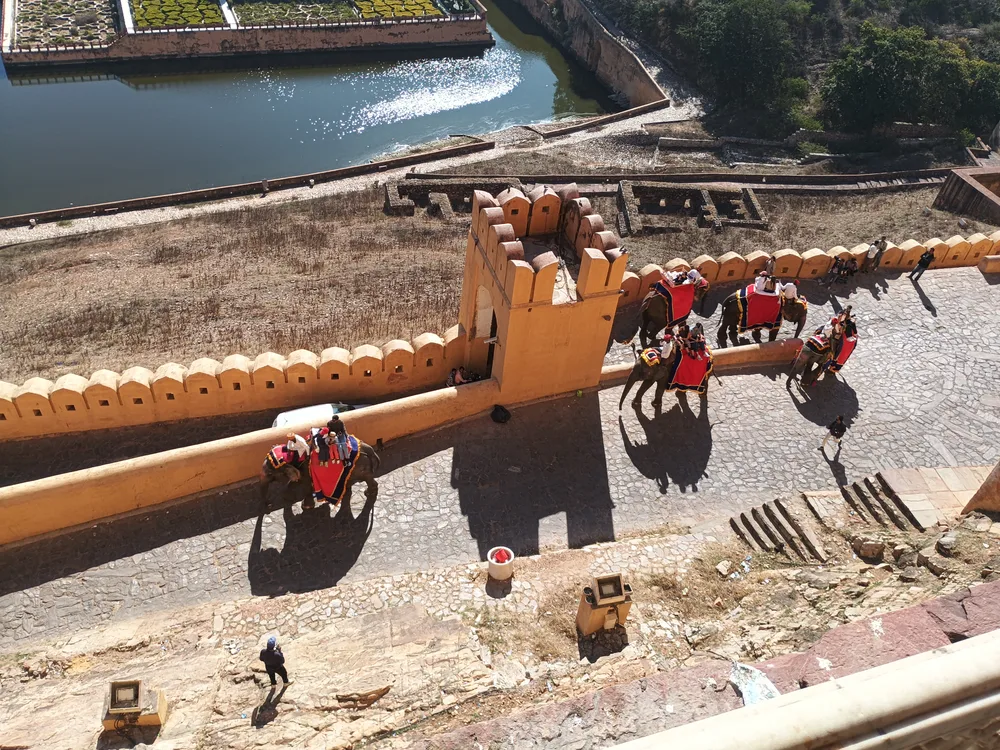
- Amber Fort — 11 km from the city, on a hill above a lake. The Sheesh Mahal hall of mirrors, courtyards, and a view of walls running along the ridges like a Great Wall. You go up by jeep (the elephant rides are fading into the past, and rightly).
- The City Palace — still home to the maharaja's family; a museum of costume and weaponry, and two silver urns in the Guinness Book of Records.
- Jantar Mantar — an 18th-century observatory of house-sized stone instruments, a UNESCO site.
- The bazaars — Johari Bazar (jewellery, textiles), Bapu Bazar (leather jootis, block-printed cotton). Jaipur is a world centre of gem cutting, but remember the warning in money in India: there are no "bargain" gemstones for resale.
How long: two nights. Jaipur is also part of the Golden Triangle — more in the Golden Triangle: what to see.
Jodhpur — the Blue City
Above the city, on a 120-metre crag, stands Mehrangarh — one of the largest and best-preserved forts in India, with palaces, a museum and terraces overlooking the whole old town painted blue. The colour traditionally marked the houses of Brahmins; today it is painted for coolness and for visitors, and from above it looks like a sea.
Beyond the fort: Jaswant Thada, a white marble cenotaph next door, Sardar Market around the clock tower — spices, textiles, tea — and Umaid Bhawan Palace, part hotel, part museum, part still the maharaja's home. Jodhpur is also the place to try laal maas, a fiery lamb curry, if you like bold flavours.
How long: one night, better two.
Jaisalmer and the Thar Desert
At the western edge of the state, 100 km from the Pakistan border, the Golden City rises out of the sand: a 12th-century fort in which several thousand people still live — one of the last "living" forts in the world. The sandstone is the colour of honey, and at sunset it glows as if lit from inside.
- Jaisalmer Fort — narrow lanes, Jain temples with lace-like carving, the maharaja's palace, terraces looking out over the desert.
- The havelis — merchants' mansions with façades carved so densely they look cut from paper. The most famous: Patwon ki Haveli.
- Gadisar Lake — an artificial reservoir with pavilions, for a quiet evening.
- A night in the Thar Desert — the Sam or Khuri dunes, 40 km from town: a camel ride at sunset, dinner by a fire with music and dance, a night in a tent with a real bed. There are so many stars it is hard to find a dark patch of sky.
How long: two nights — one in town, one in the desert. In winter the dunes drop to near zero at night; a fleece and a hat are essential.
The whole route in one trip: Golden Cities of Rajasthan — Mandawa, Bikaner, Jaisalmer with a night in the desert, Jodhpur, Pushkar, Jaipur, then the Taj Mahal and Varanasi. 16 days with a tour leader, February/March 2027.
Send me the programmePushkar — the sacred lake and the camels
A small town around a sacred lake ringed by 52 ghats, with one of the very few temples to Brahma in the world. The town is vegetarian and alcohol-free — a place of pilgrimage, not a resort. It is worth climbing (or taking the cable car) to the Savitri temple on the hill for sunrise over the lake and the desert.
In November, at the full moon of Kartik, Pushkar hosts its Camel Fair — one of the largest events of its kind in the world: tens of thousands of animals, races, moustache contests, ferris wheels. Beautiful and very crowded; hotels are booked a year ahead.
How long: one night, on the way between Jodhpur and Jaipur.
Bikaner and Mandawa — the road less travelled
If you drive from Delhi to Jaisalmer by the northern road, two places lie on the way that most tours skip:
- Mandawa in the Shekhawati region — a small town full of havelis, 18th and 19th-century merchants' houses whose walls, inside and out, are covered with frescoes: scenes from mythology, but also steam engines, aeroplanes and Europeans in bowler hats. It is called an "open-air art gallery".
- Bikaner — Junagarh Fort, one of the few in Rajasthan never conquered, with palaces finished in lacquer and mirrors. Thirty kilometres away is Deshnoke and the Karni Mata temple, home to tens of thousands of revered rats. Not for everyone, but unforgettable.
Ranthambore — tigers
In the east of the state, between Jaipur and Agra, lies Ranthambore National Park — one of the best places in India to see a Bengal tiger in the wild. Safaris run at dawn and in the afternoon, in open jeeps or larger "canters", in designated zones of the park; an 11th-century fort still stands on a crag in the middle. The park is closed from July to September.
Honestly: a tiger is never guaranteed. That is why sensible programmes — such as our Colourful India — include two safaris, which genuinely improves the odds. Even without a tiger you will see sambar deer, antelope, crocodiles, peacocks and hundreds of birds.
Udaipur — for next time
The city of lakes in the south of the state, with a palace on the water and India's most famous hotel on an island in Lake Pichola. Romantic and calmer than the rest, but off the main loop — adding it to a route through Jaisalmer extends the trip by three days. Leave it for another visit or a private itinerary; we build those on request.
How to plan the route and how many days
| Leg | Distance | Driving time |
|---|---|---|
| Delhi → Mandawa | c. 260 km | 5–6 h |
| Mandawa → Bikaner | c. 190 km | 4 h |
| Bikaner → Jaisalmer | c. 330 km | 6 h |
| Jaisalmer → Jodhpur | c. 285 km | 5 h |
| Jodhpur → Pushkar | c. 200 km | 4 h |
| Pushkar → Jaipur | c. 150 km | 3 h |
| Jaipur → Agra (via Fatehpur Sikri) | c. 240 km | 5–6 h |
Realistic times, with stops for tea and photographs, for a minibus with a driver. Trains exist, but for a group a vehicle is more comfortable and lets you stop along the way.
The full loop through all these cities is 10–12 days; with Agra and Varanasi at the end, 15–16. A shorter version (Jaipur, Pushkar, Ranthambore, Agra) fits into 8–9 days, and that is the backbone of Colourful India. How to plan a first trip in general is covered in first time in India.
When to go to Rajasthan
October to March. Days are sunny and warm (20–28°C), nights cool — near zero in the desert in December and January. November brings the Pushkar fair, February the Desert Festival in Jaisalmer, March the festival of Holi, celebrated with gusto in Jaipur. From April temperatures climb to 40°C and beyond, and the monsoon (July to September) is weak here but humid, and it closes Ranthambore. More in when is the best time to visit India.
Practicalities
- Layers. In winter, 5°C in the morning and 25°C at noon. A fleece for the desert, something light for the day.
- Shoes for forts. Lots of steps and stone ramps — comfortable, with proper soles, not sandals.
- Food. Rajasthan has its own cuisine: dal baati churma (lentils with baked dough balls), ker sangri (desert berries and beans), the sweet ghewar. Hotter than Delhi; ask for mild if you prefer. Safe-eating rules: food in India.
- Shopping. Bandhani tie-dye and block prints from Sanganer and Bagru, Jaipur blue pottery, leather jootis, miniatures painted on paper and silk. Haggle in the bazaars, not in the government emporiums.
- Temples and forts. Shoes stay outside temples; forts charge entry, often with a separate camera fee.
Frequently asked questions
How many days do you need for Rajasthan?
The core — Jaipur, Jodhpur, Jaisalmer with a night in the desert, and Pushkar — takes 8–10 days. The full loop with Mandawa and Bikaner takes 10–12, and with the Taj Mahal and Varanasi at the end, 15–16. Driving between cities takes 4–6 hours, so eight cities in a week cannot be done.
Which cities in Rajasthan matter most?
Jaipur (Hawa Mahal, Amber Fort), Jodhpur (Mehrangarh Fort above the blue city) and Jaisalmer (the living fort and the Thar Desert). Plus Pushkar with its sacred lake. Udaipur is beautiful but lies off the main loop.
When is the best time to visit Rajasthan?
October to March. Days are warm and sunny, nights cool — close to zero in the desert in December and January. From April it is over 40°C. The Pushkar camel fair is in November and the festival of Holi in March.
Is a night in the Thar Desert comfortable?
Yes, if you stay in a tented camp with real beds and bathrooms, as on our programmes. Dinner by the fire with music in the evening, sunrise over the dunes in the morning. Winter nights are cold — a fleece and a hat are essential.
Will I definitely see a tiger in Ranthambore?
There is no guarantee — these are wild animals. Two safaris at different times of day genuinely improve the odds, which is how we build the programme. Even without a tiger you will see deer, antelope, crocodiles and plenty of birds. The park is closed from July to September.
How do you get around Rajasthan?
Most comfortably by car or minibus with a driver — cities are 150–330 km apart, with places worth a stop along the way, such as Fatehpur Sikri. Trains exist, but for a group a vehicle gives flexibility and saves time.