- Is India a good first country in Asia?
- Which route to choose for a first visit
- How many days to allow
- When to go for the first time
- What to expect in the first 48 hours
- Ten rules for a first trip
- The most common beginner mistakes
- What surprises people pleasantly
- Checklist before you fly
- Frequently asked questions
Everyone has a picture of India in their head before they go — and almost everyone comes back saying it was different. Not worse, not better: different. This guide is for people planning a first trip who want to arrange it so that they come home enchanted rather than relieved it is over.
Is India a good first country in Asia?
Yes, on three conditions: the north, not the whole country; 10–15 days, not a week; and, for a first visit, an organised trip rather than going it alone. India is not hard because it is dangerous — it is hard because it is intense. Everything happens at once, louder and closer than we are used to. A well-built itinerary gives you a buffer for that.
Which route to choose for a first visit
India has 28 states and several entirely different worlds: desert Rajasthan, Himalayan Kashmir and Ladakh, the tropical south, the holy cities on the Ganges. Trying to see two of them in one trip is the most common beginner's mistake. For a first visit, three options work:
- The Golden Triangle plus Varanasi — Delhi, Jaipur, Agra and the city on the Ganges. The best ratio of impressions to effort; we cover it in the Golden Triangle: what to see. Our Pearls of North India follows this formula in 12 days, adding Orchha and Khajuraho on the way.
- Rajasthan with tigers — a longer loop through Jaipur, Pushkar, Ranthambore, Agra and Varanasi. More days and more variety: desert, safari, the Taj Mahal, the Ganges. That is Colourful India, 15 days.
- Beach plus a short circuit — for people who mostly want to rest: a week or two in Goa and a 3-day trip to Jaipur, Agra and Delhi, as in India in a Nutshell. Less of India, but without the fatigue.
What not to do on a first visit: do not combine north and south, do not head into the Himalayas without knowing how you react to altitude, and do not plan "all of India in 10 days". It is not a country you tick off.
How many days to allow
The sensible minimum is 10 days on the ground, ideally 12–15. Three reasons:
- Jet lag and acclimatisation. Depending on where you fly from, the time difference is several hours, and the first day in Delhi is an experience in itself. Treat day one as "day zero".
- Distances. Delhi to Jaipur is 270 km, but realistically 5–6 hours on the road. Agra to Varanasi is an overnight train or a flight. Every transfer between cities eats half a day.
- The "one city, two nights" rule. One night means arriving in the evening, sightseeing in the morning and moving on. Two nights give you a full day and an unhurried evening.
A week including long-haul flights is in practice five days in India — enough for the Golden Triangle alone, but it will be a sprint, not a journey.
When to go for the first time
For northern India — October to March. December and January can be foggy and chilly in the morning (a few degrees in Delhi, close to zero at night in the Rajasthan desert), but the days are pleasant. February and the first half of March are the sweet spot: warm, dry, no extreme heat. From April it gets hot, and from June to September the monsoon runs — not for a first visit.
The full picture region by region, from Rajasthan to Kashmir and Ladakh, is in when is the best time to visit India.
What to expect in the first 48 hours
This is the most important part of the article, because the first two days decide how you will remember the whole trip. Honestly:
- Noise. In India the horn is a means of communication, not an expression of anger. After two days you stop hearing it.
- Crowds and proximity. Personal space is smaller than at home. In a bazaar someone will always be right next to you — that is normal, not a threat.
- Smells. Incense, spices, exhaust, flowers, rubbish — often in a single breath. Your nose adjusts.
- Poverty and begging. You will see it, particularly in Delhi. It cannot be "solved" with small change; your tour leader will suggest how to respond with respect, without guilt and without drawing a crowd.
- Curiosity. People will look at you and ask for a photo together, especially outside Delhi. It is friendly interest — you can agree or politely decline.
- Cows, monkeys, dogs. In the streets, in temples, on station platforms. Do not touch, do not feed, and keep food out of sight around monkeys.
- Time. "Five minutes" can be an elastic concept. Rather than fight it, accept it — that is what a programme with buffers is for.
The good news: by the third day most people feel at home in India. The first-day shock is real, but short.
A first trip without the stress? Pearls of North India is the classic route at an unhurried pace, with a tour leader from airport to airport. A group for early December 2026 is forming now.
Send me the programmeTen rules for a first trip
- Bottled water only — for brushing your teeth too. Skip ice outside good hotels.
- Eat what is hot and freshly cooked. The rest of the food rules are in food in India.
- Closed, comfortable shoes for the city; easy to slip off for temples.
- Shoulders and knees covered in temples and mosques; women often need a scarf for the head (in Sikh gurdwaras, everyone does).
- Small notes always to hand: for tea, tips, toilets, rickshaws.
- Right hand for eating and passing things — the left is considered unclean.
- Haggle in the bazaar, not in shops with price tags. Start at half, finish with a smile.
- No photographs of cremations in Varanasi, and none of people without asking. Ask — they usually say yes.
- Sunscreen and a hat even in February. The sun at 27° north is stronger than most Europeans expect.
- Patience — the most useful thing you cannot pack.
The most common beginner mistakes
- Too many cities in too little time. The result: you remember hotels and the bus, not India.
- The wrong season. May in the north is 42°C. August is the monsoon. Check before you buy the ticket.
- Sandals in Old Delhi. The streets are dirty and uneven; one day and you will regret it.
- No insurance with medical cover. Private clinics in India are good, but they charge up front.
- Expecting European punctuality. A train can run three hours late. A good operator has a plan B; you bring the patience.
- Overestimating danger and underestimating the sun. Far more people have trouble with heat and dehydration than with any crime — we wrote about it in is India safe to travel.
- A last-minute visa. The e-Visa usually arrives in 2–4 days, but corrections happen. Apply 2–3 weeks before you fly.
What surprises people pleasantly
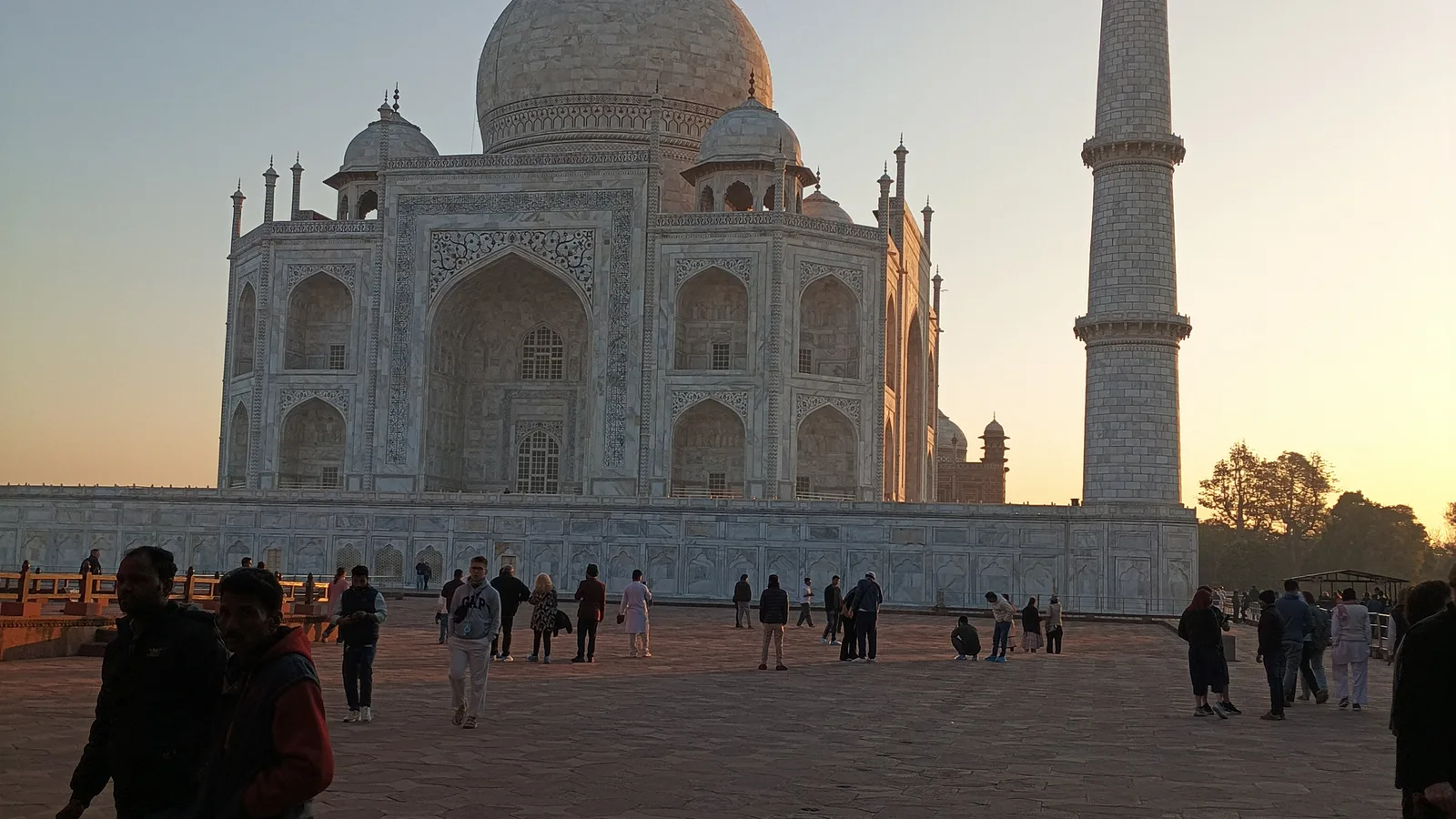
After a first trip, people most often mention four things: kindness — strangers invite you for tea and help without being asked; food — it turns out not everything is hot, and most of it is superb; colour — saris, turbans, spice bazaars that no photograph does justice to; and the fact that the Taj Mahal really does live up to it, even after seeing it a thousand times on a screen.
A fifth thing, mentioned less often: in a group with a tour leader, the sense of security is greater than on many trips around Europe. Someone always knows where we are, where we are going and what to do when things change. Why that matters in India specifically is the subject of guided tour or independent travel in India.
Checklist before you fly
- Visa — e-Visa online, passport valid for at least 6 months. Step by step: do you need a visa for India.
- Vaccinations and a medical kit — a travel clinic appointment 6–8 weeks before departure. The list: vaccinations and a travel medical kit.
- Insurance with medical cover of at least 30,000 EUR, preferably more.
- Money — a card plus cash in euros or dollars to exchange on arrival; rupees are only available in India.
- Copies of documents — passport and visa on your phone and on paper, kept separately from the originals.
- Luggage — the list, including the plug adapter and temple-appropriate clothing: what to pack for India.
Frequently asked questions
How many days are enough for a first trip to India?
A minimum of 10 days on the ground, ideally 12–15. A week including long-haul flights is really five days in India — enough for the Golden Triangle alone, but at a pace that tires rather than delights.
Is India difficult for beginners?
Intense rather than difficult. The noise, crowds and contrasts of the first day are real, but most people feel comfortable by day three. An organised trip with a tour leader takes the logistics off your hands and lets you concentrate on India itself.
What is the best route for a first visit?
The classic north: Delhi, Jaipur, Agra with the Taj Mahal, and Varanasi on the Ganges. It offers the most variety at reasonable distances. Do not combine it with the south or the Himalayas in a single trip.
When should I go to India for the first time?
To the north, between October and March. February and the first half of March are the most pleasant: warm, dry and without extreme heat. December and January can be foggy and cool in the mornings, it gets hot from April, and the monsoon runs from June.
Do I need to speak English to travel in India?
Travelling alone — it helps a great deal. In a group with a tour leader — no. The tour leader handles guides, menus and formalities, and a few phrases are only needed for small purchases.
What do first-time visitors worry about most, and are they right?
Usually food, illness and safety. In practice most problems are dehydration, sun and minor stomach upsets, all easy to prevent: bottled water, hot food, sunscreen and a medical kit. Crime against travellers in an organised group is rare.