If you are going to India for the first time, you will almost certainly come across the phrase Golden Triangle. It is the most classic route in the country, and not without reason. In a few days it shows you three completely different faces of India: chaotic, many-layered Delhi, Agra with the Taj Mahal, and Jaipur, the Pink City of Rajasthan.
What the Golden Triangle is
The Golden Triangle is the route linking Delhi, Agra and Jaipur. The name comes from geography — on a map the three cities form an almost equilateral triangle, and the full loop runs to roughly 700 to 750 kilometres.
Its popularity comes from the sheer density of monuments. Within that small area sit several UNESCO World Heritage sites: the Taj Mahal, Agra Fort and Fatehpur Sikri around Agra; Qutub Minar and Humayun's Tomb in Delhi; the hill forts of Rajasthan and Jantar Mantar around Jaipur.
There is one more reason it works well as a first route: each city shows a different chapter of Indian history. Delhi is a set of overlapping layers — the sultanate, the Mughal empire and the British colonial capital. Agra is the peak of Mughal architecture. Jaipur is princely Rajasthan, planned and built to a grid.
How many days to realistically allow
This question decides whether you come home delighted or exhausted. The honest answer is: it depends how much hurry you are willing to accept.
- 3 days — the express version. Possible, but it is sightseeing at a run, one day per city, with long drives. It makes sense as an addition to another stay in India — a break from the beaches of Goa, for instance.
- 5 to 6 days — the comfortable minimum. Two days in Delhi, one full day in Agra, two days in Jaipur, plus the driving. Enough to see the essentials without feeling chased.
- 7 to 8 days — an unhurried pace. Fatehpur Sikri joins the route, and there is time for the bazaars, for a slow dinner and for simply sitting and looking. On a first visit to India this is a very good choice.
- 10+ days — the Golden Triangle and more. If you are flying in from Europe, this is in our view the most sensible option. Since you are spending the better part of a day in transit anyway, it is worth seeing more than the loop alone.
Delhi — what to see
Delhi can be a shock on arrival — loud, crowded, intense. But it is also a city of remarkable historical depth, in which Old and New Delhi are practically two different worlds.
Old Delhi
- Jama Masjid — one of the largest mosques in India, built under Shah Jahan. The courtyard gives a fine view over the surrounding city.
- Chandni Chowk — the famous bazaar of Old Delhi. A rickshaw ride through its narrow lanes is one of those experiences that stays with people for years.
- The Red Fort (Lal Qila) — the Mughal fortress of red sandstone, a UNESCO site and the former imperial residence.
New Delhi
- Humayun's Tomb — a UNESCO site and the architectural forerunner of the Taj Mahal. Seeing it before Agra makes the Taj read entirely differently.
- Qutub Minar — a twelfth-century brick minaret, also on the UNESCO list.
- India Gate — the memorial to fallen soldiers, at the heart of the ceremonial city.
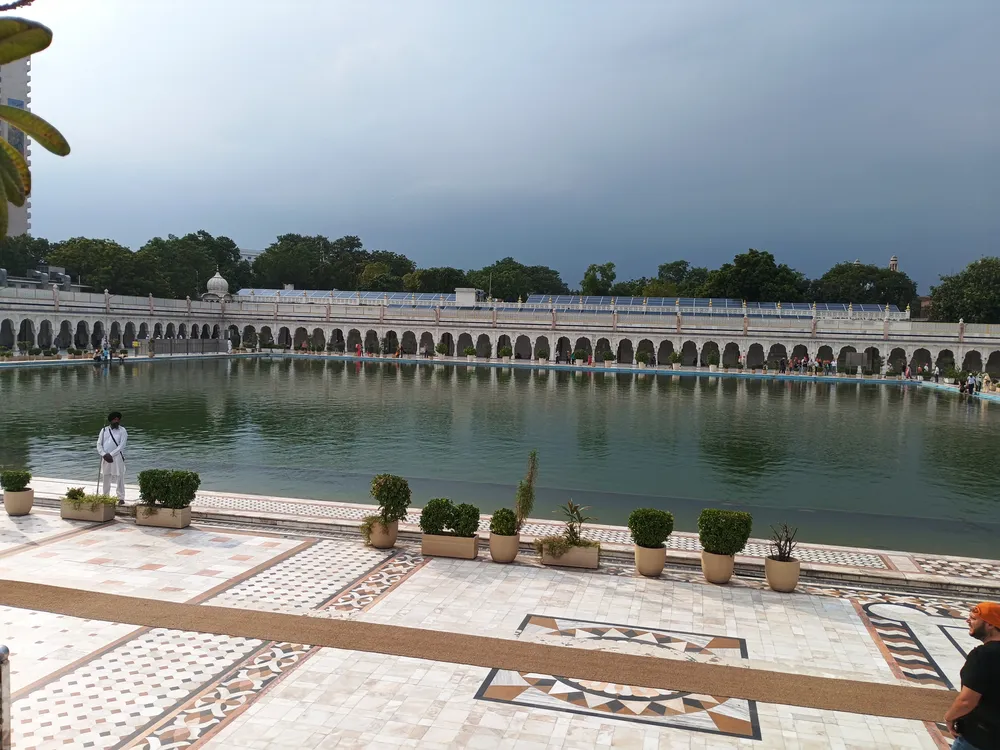
- The Lotus Temple and Gurudwara Bangla Sahib — the Sikh temple with its vast communal kitchen is one of the most moving places in Delhi.
Agra — the Taj Mahal and more
Agra is the shortest stop on the route, but it holds its greatest star. It is worth knowing that the city is not only the Taj Mahal.
The Taj Mahal
Built in the seventeenth century by the emperor Shah Jahan as a mausoleum for his wife Mumtaz Mahal. It took more than two decades, in white marble, on the bank of the Yamuna. Photographs convey neither the scale nor the way the marble changes colour with the light.
Two things to know in advance: the Taj Mahal is closed to visitors on Fridays, and the best time to visit is sunrise — for the light, and for the crowds, which build through the day. Our programmes are built around an early start.
The rest of Agra
- Agra Fort — a massive red sandstone fortress and UNESCO site. This is where Shah Jahan spent his final years, imprisoned by his own son, with a view of the mausoleum he had built.
- Itimad-ud-Daula, known as the Baby Taj — a smaller, intricately decorated tomb, and far quieter than the main attraction.
- Mehtab Bagh — the garden across the river, with the classic view of the Taj Mahal from behind. Excellent at sunset.
Not keen on putting this together yourself? We run the whole Delhi – Agra – Jaipur route with a private driver and an English-speaking tour leader. Already on Goa? The same Taj Mahal is reachable on a short trip flying up from Goa.
See the tripFatehpur Sikri — the stop on the way
About 40 km from Agra, on the road to Jaipur, lies Fatehpur Sikri, the abandoned city built by the emperor Akbar as a new imperial capital. Raised in red sandstone, inhabited for barely more than a decade and then left; the shortage of water is the most commonly cited reason.
Today it is one of the best-preserved complexes of Mughal architecture and a UNESCO site. It sits directly on the route, so adding it costs no detour at all — allow two or three hours for the stop. It would be a shame to drive past.
Jaipur — the Pink City
The capital of Rajasthan and, for many travellers, the most enjoyable point on the whole route. The city was founded in 1727 by Maharaja Sawai Jai Singh II and planned from scratch on a regular grid — a rarity in India.
The nickname has a specific origin: in 1876 the old city was painted pink — the colour of hospitality — to welcome the visiting Prince of Wales. The colour stayed.
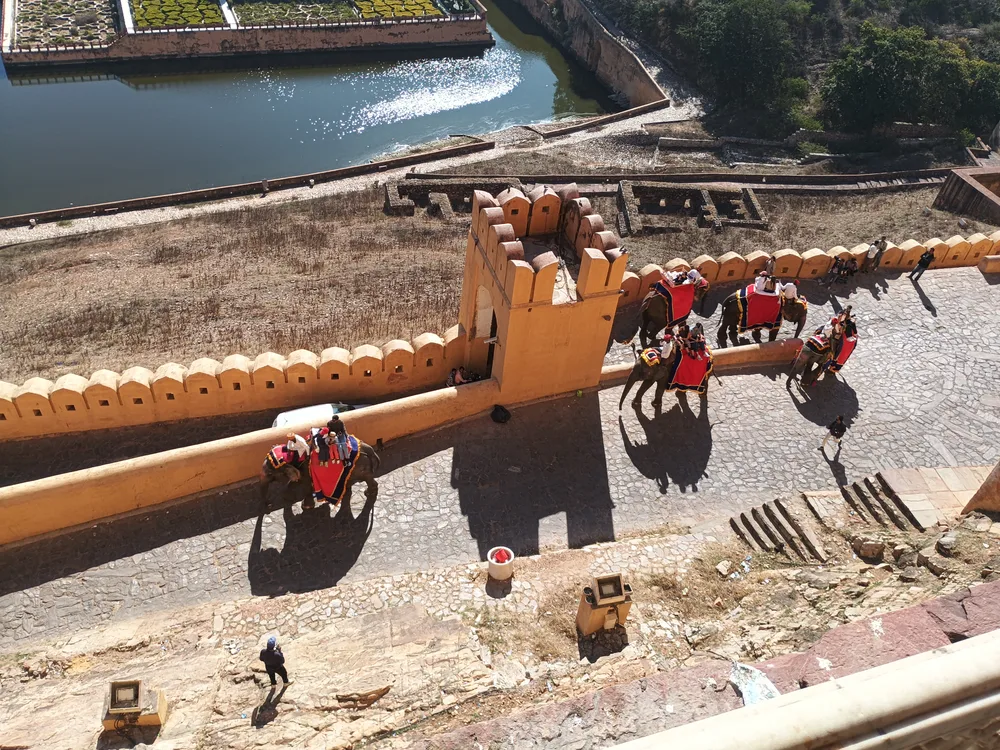
- Amer Fort (Amber) — an imposing hill fortress above a lake, with courtyards, a hall of mirrors and views along the surrounding walls. UNESCO-listed among the hill forts of Rajasthan.
- Hawa Mahal, the Palace of Winds — the most recognisable facade in India, built in 1799. Hundreds of small windows allowed the women of the court to watch the life of the street while remaining unseen.
- City Palace — the palace complex at the heart of the city, still partly inhabited by the family of the former rulers.
- Jantar Mantar — an eighteenth-century astronomical observatory and UNESCO site, home to the largest stone sundial in the world.
- Jal Mahal — the Water Palace, seen from the shore of Man Sagar lake; particularly striking in morning light.
Jaipur is also the best place on the route for shopping and crafts — textiles, traditional block printing, jewellery. It is worth leaving half a day for it.
Distances and driving times
| Section | Distance | Driving time |
|---|---|---|
| Delhi → Agra | approx. 230 km | 3–4 h by expressway |
| Agra → Fatehpur Sikri | approx. 40 km | about 1 h |
| Fatehpur Sikri → Jaipur | approx. 200 km | 4–5 h |
| Jaipur → Delhi | approx. 280 km | 5–6 h |
Times are approximate and depend heavily on traffic, particularly leaving and entering Delhi. This is precisely why our trips use private transport with an experienced driver rather than public connections: a delay on one section does not then unravel the rest of the day.
Frequently asked questions
How long is the Golden Triangle route?
The full loop of Delhi, Agra and Jaipur is roughly 700 to 750 kilometres. On a map the three cities form an almost equilateral triangle, which is where the name comes from.
Can the Golden Triangle be done in three days?
It can, but it means one day per city and long drives in between. It makes sense as an add-on to another stay in India, such as a break from the beaches of Goa, rather than as a trip in its own right from Europe.
Is the Taj Mahal open every day?
No. The Taj Mahal is closed to visitors on Fridays. It is worth checking this against your itinerary before booking anything else in Agra.
What is the best time of day to see the Taj Mahal?
Sunrise, both for the light on the marble and for the crowds, which build steadily through the day. Our programmes are built around an early start for exactly this reason.
Is Fatehpur Sikri worth the detour?
There is no detour involved — it sits directly on the road between Agra and Jaipur, so it costs you two or three hours of stopping time. For one of the best-preserved Mughal complexes in India, that is a very good trade.
Which city is the most enjoyable?
For most travellers, Jaipur. It is more relaxed than Delhi, more varied than Agra, and it is the best place on the route for crafts and shopping.