The Taj Mahal is a building everyone has seen a thousand times — and which still, when you finally stand in front of it, leaves you speechless. We know this from experience: even people who said before the trip "fine, we'll tick it off" end up standing in the gateway longer than they planned. To make that moment what it should be, it helps to know a few things about hours, tickets and crowds. Here they are.
The short answer
Arrive for opening, at dawn, enter through the East Gate, carry only a small bag, your phone and water, and buy your ticket in advance. Stay at least two hours. And check the day of the week: the Taj Mahal is closed on Fridays.
A little history — just enough
The Taj Mahal is the mausoleum that the Mughal emperor Shah Jahan built for his beloved wife Mumtaz Mahal, who died in 1631 giving birth to their fourteenth child. Construction began in 1632; the main mausoleum stood after a dozen or so years, and the whole complex was completed around 1653. Some 20,000 craftsmen worked on it, and the white marble was brought from Makrana in Rajasthan, more than 300 km away.
Shah Jahan himself ended worse than his building: his son Aurangzeb deposed and imprisoned him in Agra Fort, from where he spent his last years looking at the Taj through a window. After his death he was laid to rest beside his wife — and his cenotaph is the one element of the entire design that breaks the perfect symmetry.
The Taj Mahal has been a UNESCO World Heritage Site since 1983, and in 2007 it was named among the "New Seven Wonders of the World".
Opening hours and tickets
- Hours: from 30 minutes before sunrise to 30 minutes before sunset, every day except Friday.
- Night viewing: on a few nights around the full moon (excluding Fridays and the month of Ramadan), in short slots with a limited number of tickets. A separate booking, and one for the determined.
- Tickets for foreign nationals: roughly 1,100 rupees for the grounds plus a further 200 rupees to enter the mausoleum itself — about 13–15 EUR in total. Prices are revised every few years, so treat this as an order of magnitude. Indian citizens pay a fraction of that.
- Where to buy: online from the Archaeological Survey of India (a QR code on your phone is enough) or at the ticket office by the gate. Online saves a queue that can be long at dawn. On our trips tickets are bought in advance for the whole group.
- Time limit: you may stay on the grounds for up to 3 hours from entry — plenty.
Which gate to use and what not to bring
Three gates lead into the complex: the East Gate (off Fatehabad Road, most convenient for hotels and groups), the West Gate (the busiest, nearer the city centre) and the South Gate, which currently serves mainly as an exit. Cars and coaches must stop several hundred metres from the gates — from there you take an electric shuttle or walk, which takes a few minutes.
There is airport-style security at the entrance. You cannot bring in: food, tobacco, lighters, tripods, drones, large backpacks, headphones or chargers. You may carry a phone, a camera (without a tripod), a small bag, a bottle of water and a wallet. Everything else stays in the vehicle or at the cloakroom by the gate. Photography is forbidden inside the mausoleum, and you step onto the marble platform in shoe covers, provided with the ticket, or barefoot.
How to see everything
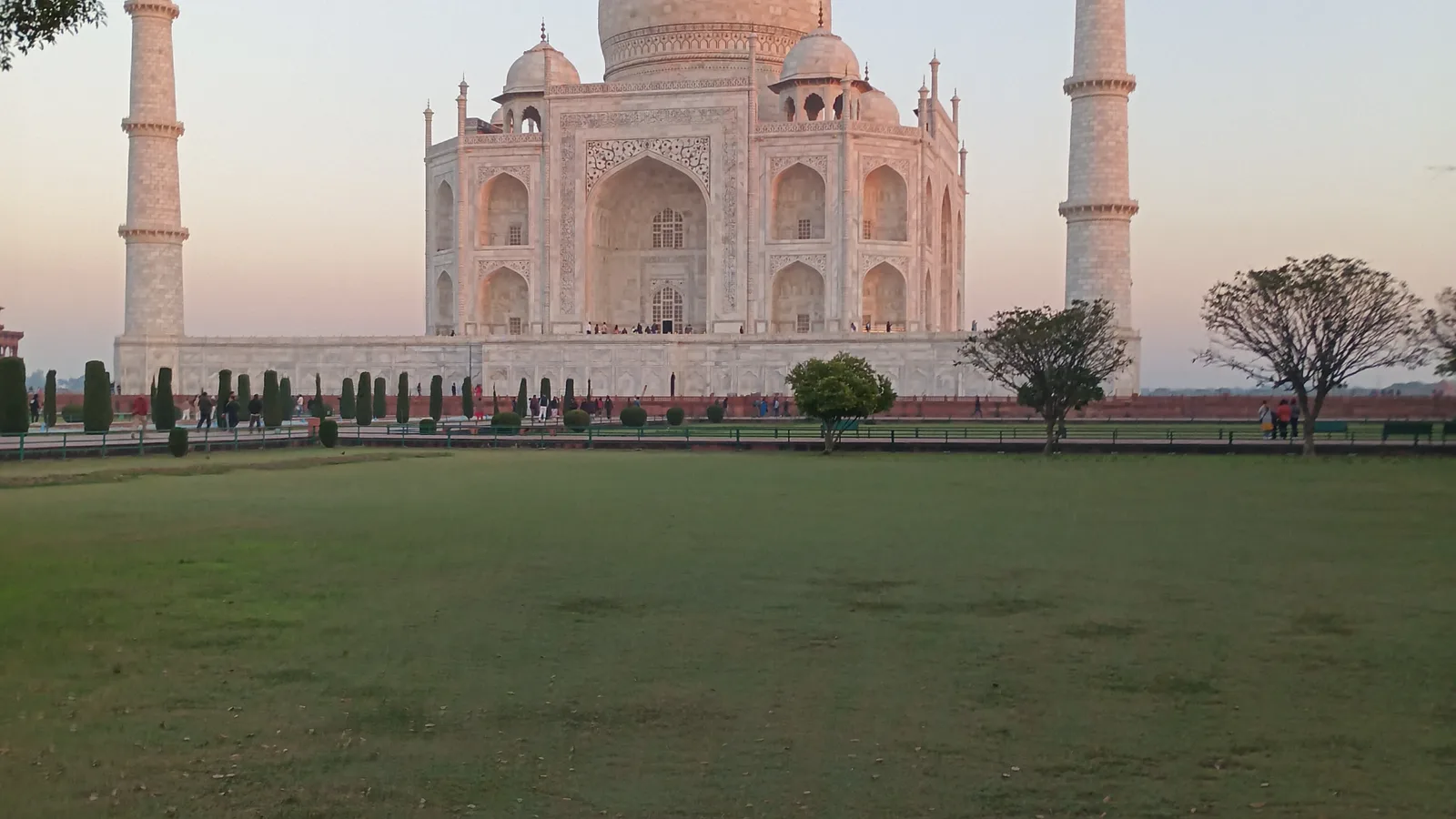
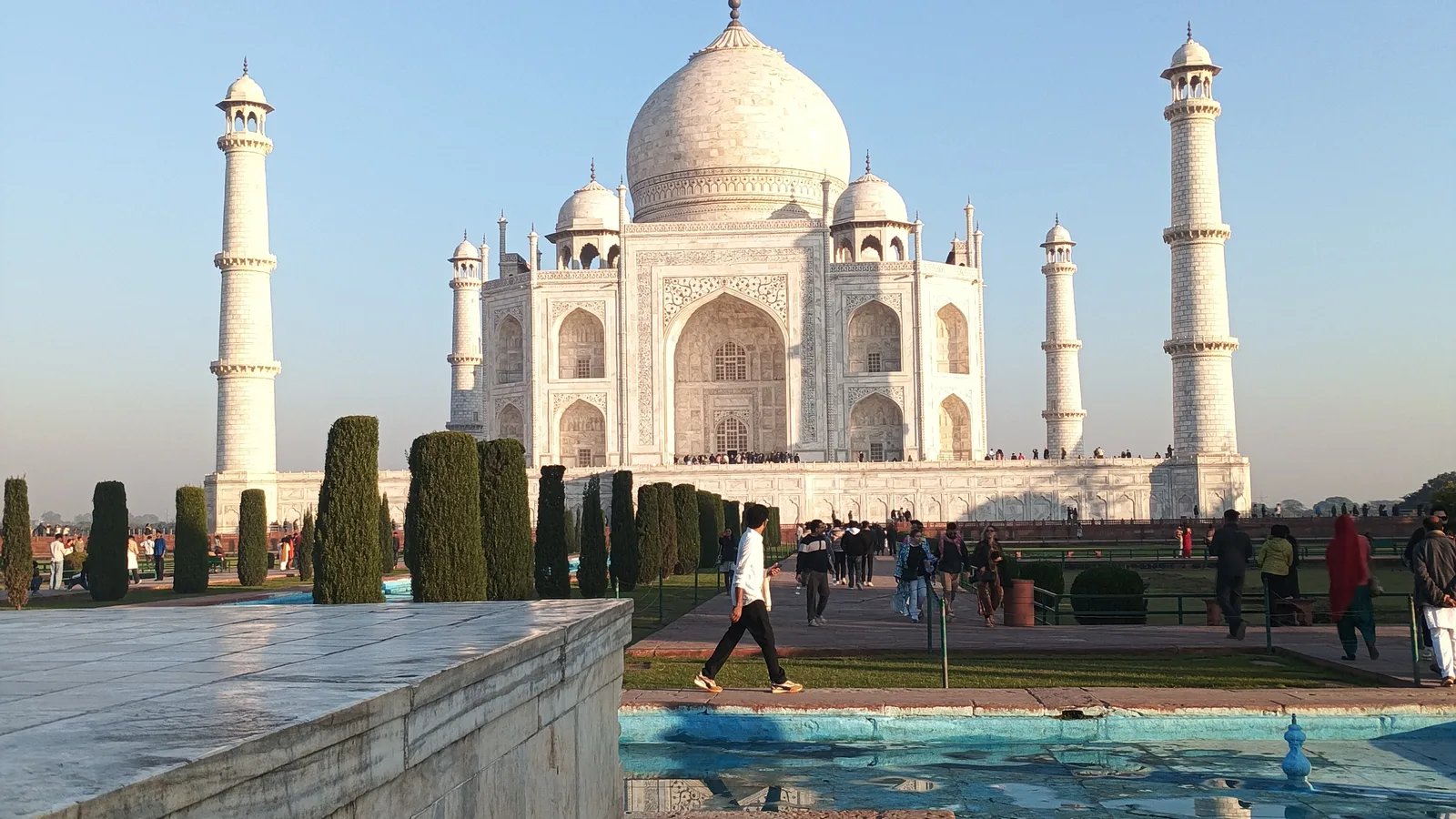
- The main gateway (Darwaza-i-Rauza). Stop in its arch — this is the most famous view, with the mausoleum framed in red sandstone and calligraphy. Be among the first of your group to stand here, before the terrace fills.
- The charbagh gardens and the pool. Four quarters divided by water channels, with a raised reflecting pool at the centre. This is where "Diana's bench" is — the one from the 1992 photograph of the princess; the queue for a photo on it can be a hundred people long.
- The platform and the mausoleum. Up close you see what the postcards miss: pietra dura, inlay of jasper, jade, lapis lazuli and carnelian arranged into flowers, and calligraphy from the Quran. Inside are the cenotaphs of the imperial couple (the actual graves lie in a crypt below, closed to visitors).
- The mosque and the "answer". On the western side stands a red sandstone mosque; on the eastern side its mirror copy, built purely for symmetry. From their arches you get the best side views of the mausoleum, in shade and without crowds.
- The riverbank. Behind the platform, above the Yamuna, it is usually quietest. Across the water you can see the Mehtab Bagh garden.
The Taj Mahal at dawn is on every trip we run to northern India — Pearls of North India, Colourful India and Golden Cities of Rajasthan. Tickets bought in advance, a guide at the gate, and a tour leader making sure nobody oversleeps.
Ask about a tripFacts worth knowing as you stand in front of it
- The minarets lean slightly outwards. Deliberately — in an earthquake they were meant to fall away from the mausoleum, not onto it.
- The calligraphy grows towards the top. The letters on the higher sections are larger, so that from below they all look the same size. Its author, Amanat Khan, was the only artist allowed to sign his work.
- The marble changes colour — pink at dawn, white by day, golden at sunset, bluish under a full moon. That is the translucency of Makrana stone, not legend.
- The "Black Taj" — the tale of a mirror mausoleum in black marble across the river that Shah Jahan never got to build. Historians have found no evidence for it, but tour guides tell it to this day.
- During wars the Taj was "hidden". In 1942 and again in 1965 and 1971 the dome was surrounded with scaffolding and covered so that it would not serve as a landmark for aircraft.
- The marble yellows from pollution and is periodically cleaned — with clay. A paste of multani mitti, the same clay Indian women use as a face mask, is applied to the façade and rinsed off with water once dry.
Where to take photographs
- The arch of the main gateway — the classic, just after you enter.
- The middle of the pool from the gateway side — the reflection in the water, crowd-free at dawn.
- The arches of the mosque on the left — a framed side view with an empty foreground.
- Mehtab Bagh across the river — at sunset, with the whole silhouette in warm light and no Taj ticket needed.
- Agra Fort — from the terraces where Shah Jahan spent his last years, the view "from his window".
One note: tripods and drones are banned, and at peak hours security discourages long photo sessions on the platform. Dawn solves both problems.
What else to see in Agra
Agra is more than the Taj. In a single day you can also see:
- Agra Fort — a mighty Mughal fortress of red sandstone with white marble palaces inside and a view of the Taj from the Musamman Burj terrace. Worth two hours in its own right.
- Itimad-ud-Daulah, known as the "Baby Taj" — a tomb that predates the Taj Mahal and was the first to use marble inlay on such a scale. Small, intimate, usually empty.
- Mehtab Bagh — the garden on the opposite bank of the Yamuna, for sunset.
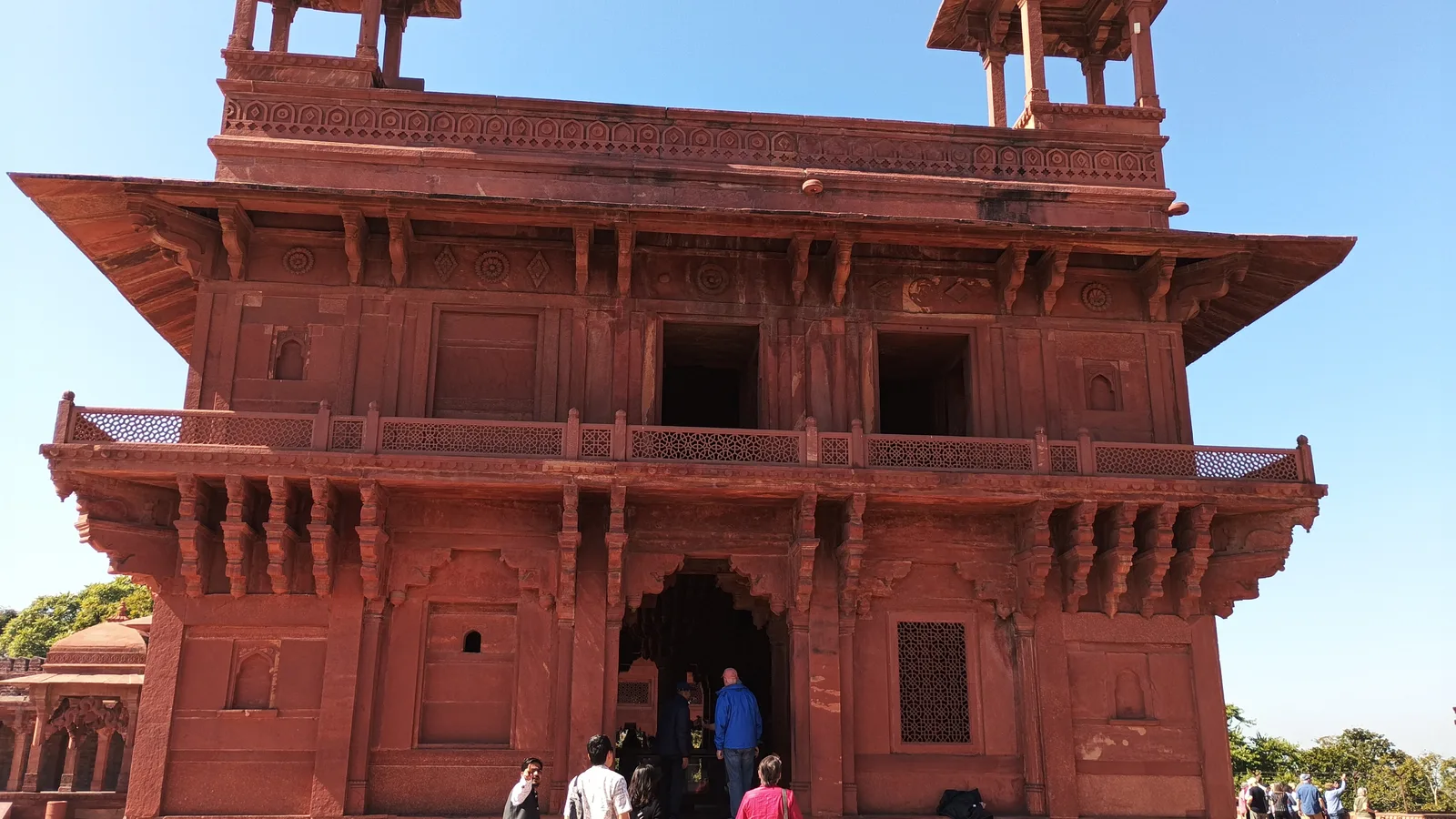
- Fatehpur Sikri — 40 km to the west, the abandoned 16th-century capital of Emperor Akbar, with one of the largest gateways in India. Usually visited on the way between Jaipur and Agra, as on our programmes.
Logistics: getting there and when
Delhi to Agra is about 230 km — 3.5–4 hours on the Yamuna Expressway or under two hours on the Gatimaan Express train. From Jaipur it is 5–6 hours, with a stop at Fatehpur Sikri. East from Agra, to Varanasi, the overnight train is the most convenient. That is why Agra is the natural middle of any route through northern India — we describe it in the Golden Triangle: what to see.
The best season is October to March. One warning: in December and January morning fog can hide the Taj completely — in those months it is worth having an afternoon visit in the plan as well. From April the terrace is at 40°C and the white marble dazzles; in the monsoon it is humid, but the gardens are green and there are fewer visitors. More in when is the best time to visit India.
If your trip starts on the beaches of Goa, the Taj Mahal can be seen on a short excursion — that is how India in a Nutshell and Delhi and Agra from Goa work.
Frequently asked questions
What is the best time of day to visit the Taj Mahal?
At opening, about half an hour before sunrise. The crowd is several times smaller, the light is soft and the marble shifts from pink to white. By ten in the morning there are thousands of people on the terrace.
How much is a Taj Mahal ticket for foreign visitors?
Roughly 1,100 rupees for the grounds plus a further 200 rupees to enter the mausoleum — around 13–15 EUR in total. Prices are revised every few years, so check the current amount before you travel. Tickets can be bought online.
Which day is the Taj Mahal closed?
Fridays — it is closed to visitors all day. On other days it is open from 30 minutes before sunrise to 30 minutes before sunset.
What can I not bring into the Taj Mahal?
Food, tobacco, lighters, tripods, drones, large backpacks, headphones and chargers. You may carry a phone, a camera without a tripod, a small bag and a bottle of water. Photography is forbidden inside the mausoleum.
How long should I allow for the Taj Mahal?
Two to three hours. That covers the gateway, the gardens, the platform, the interior of the mausoleum, the mosque and photographs. The maximum stay on the grounds is 3 hours from entry.
Is the Taj Mahal visible at sunrise in winter?
Usually, but in December and January morning fog can hide it completely for an hour or two. In those months it is worth planning an afternoon visit as well, or the view from Mehtab Bagh at sunset.