- The short answer: what not to miss
- The ghats — the riverbank where the whole city lives
- The dawn boat ride
- Ganga Aarti — the evening ceremony
- The cremation ghats — how to behave
- The old town and the Golden Temple
- Sarnath — the Buddha's first sermon
- Food and shopping
- When to go and how to get there
- Practical tips
- Frequently asked questions
Varanasi divides people into two groups: those who want to come back, and those who need a week to digest it. There is no third group — nobody leaves indifferent. It is the holiest city of Hinduism, one of the oldest continuously inhabited cities in the world, and a place where life, prayer and death happen side by side on a single riverbank.
This guide covers what to see, how to do it respectfully, and what to expect so that Varanasi enchants you rather than overwhelms you.
The short answer: what not to miss
- A boat ride on the Ganges at dawn — the single most important experience in the city.
- The Ganga Aarti ceremony at Dashashwamedh Ghat at dusk.
- A walk along the ghats and through the lanes of the old town.
- Sarnath — where the Buddha gave his first sermon, 10 km from the centre.
For all of that you need two nights: one evening for the Aarti, one morning for the boat, a day for Sarnath and the old town. One night is not enough, because the best things happen at dusk and at dawn.
The ghats — the riverbank where the whole city lives
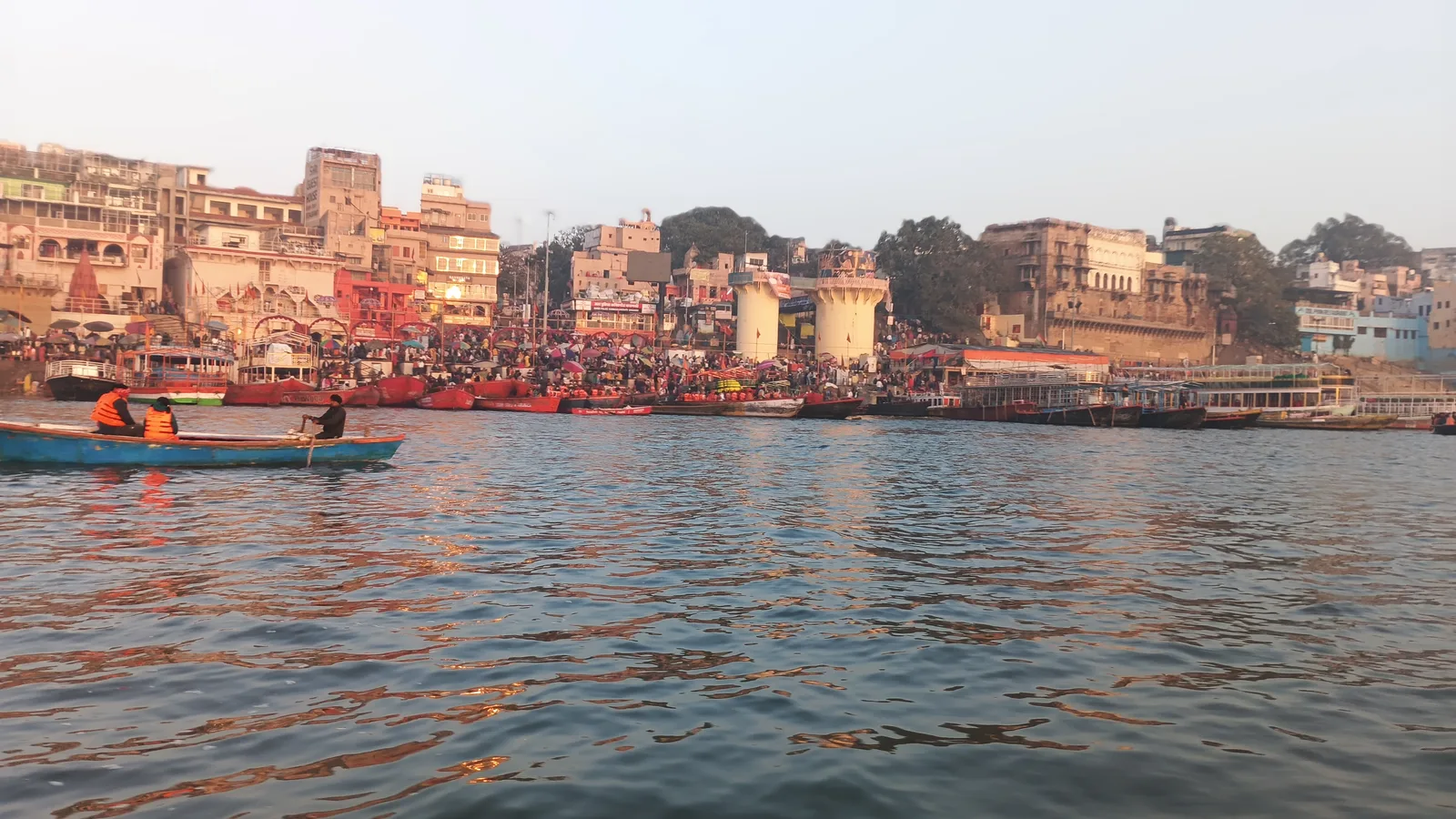
The ghats are stone steps leading down to the Ganges — more than eighty of them, stretching several kilometres along the western bank. In the morning people bathe here, pray, do laundry, practise yoga and play cricket; in the evening they light lamps. A few worth knowing:
- Dashashwamedh — the main and busiest ghat, and the setting for the evening Ganga Aarti.
- Manikarnika — the main cremation ghat. Pyres burn here around the clock, and the wood is weighed on huge scales right next to them. More on how to behave here below.
- Harishchandra — the second, smaller cremation ghat to the south.
- Assi — the calmer southern end; a morning ceremony and cafés nearby.
- Panchganga — with Aurangzeb's mosque towering over the bank, a good viewpoint.
The best way to see the ghats is on foot, from Assi to Manikarnika (about 3 km), early in the morning or late in the afternoon — at midday the stone heats up and the crowds build.
The dawn boat ride
The boat pushes off before sunrise — in winter that is around six in the morning. You drift slowly along the ghats, watching the city wake up on the bank as the first light falls on the sandstone palaces. Along the way the boatman rows past the cremation ghats (at a distance) and stops so that you can float a lamp with flowers on the water — a diya, sold for a few rupees by women on the steps.
Important: choose a traditional rowing boat, not a motorboat — the silence is half the experience. On our trips the boat ride is part of the programme, reserved in advance, so there is no negotiating with boatmen on the bank.
Ganga Aarti — the evening ceremony
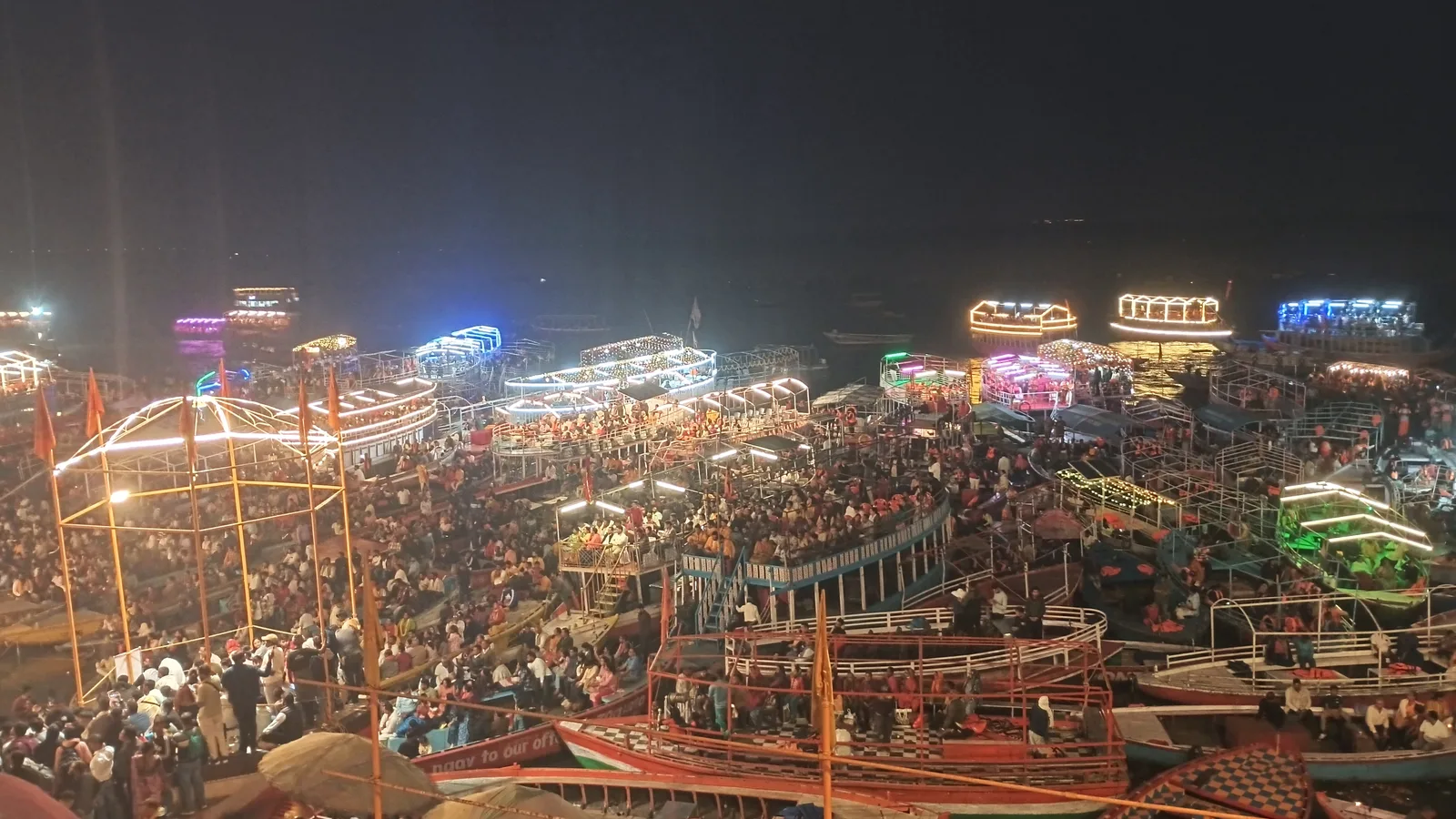
Every evening at dusk (around 6 pm in winter, 7 pm in summer) a group of young priests performs the Ganga Aarti at Dashashwamedh Ghat — an offering of fire to the river. Bells, conch shells, chanting, great brass lamps of burning camphor raised in synchronised movements, clouds of incense, and a crowd in the thousands. It lasts about 45 minutes.
How to watch:
- From a boat on the river — the best view and the least crush. Boats line up opposite the ghat like an amphitheatre.
- From the bank — arrive an hour early for a place. More intense, closer to the people.
- From the terraces of buildings by the ghat — sometimes for a small fee; comfortable, but at a distance.
After the ceremony the crowd disperses through narrow lanes — stay with the group and the tour leader, because it is easy to get separated, and phone reception in Varanasi after dark is not guaranteed.
The cremation ghats — how to behave
For many visitors this is the hardest part of the visit and at the same time the one that says most about India. Hindus believe that dying in Varanasi and being cremated by the Ganges frees the soul from the cycle of rebirth — which is why people come here from across the country to die. The pyres at Manikarnika burn without pause, and the ceremony is public, led by the closest male relatives.
You may watch, from a distance and in silence. The rules we keep to:
- No photographs or video — without exception. Camera away, phone in your pocket.
- Do not approach the pyres or walk among the mourners.
- Do not engage with the "guides" who offer to explain the cremations and then ask for a donation "for wood for the poor". It is an established hustle.
- If it is too much — simply walk away. Nobody expects you to watch.
Varanasi is on three of our programmes. On Pearls of North India you fly in from Khajuraho; on Colourful India and Golden Cities of Rajasthan you arrive by overnight train from Agra. Each includes the dawn boat ride, the Ganga Aarti and Sarnath.
Ask about a tripThe old town and the Golden Temple
Behind the ghats begins a labyrinth of lanes two people wide, where you pass cows, cycle rickshaws, paan sellers, silk workshops and tiny shrines. It cannot be visited "to plan" — you simply get lost in it for an hour, ideally with someone who knows the way back.
At the heart of the old town is Kashi Vishwanath — the Golden Temple dedicated to Shiva, one of the most important sites in Hinduism. Its spires were gilded in the 19th century. Since 2021 a wide corridor has linked it to the river, making access simpler. Foreign visitors are admitted on showing a passport, but the rules change from time to time, and bags, phones, cameras and leather items must be left at the cloakroom — your tour leader checks the current conditions on the spot.
Also worth a look: the Bharat Mata temple, with a great marble relief map of India in place of a deity, and — if there is time — the new Vishwanath temple on the campus of Banaras Hindu University, open to everyone.
Sarnath — the Buddha's first sermon
Ten kilometres from the bustle of the ghats lies Sarnath, where the Buddha gave his first sermon after reaching enlightenment — around the 5th century BC. Today it is a quiet archaeological park with the ruins of monasteries, the Dhamek Stupa (28 m across, almost 44 m high) and the spot where Ashoka's pillar stood. Its capital with four lions — now the national emblem of India — is in the museum here.
Sarnath is a good counterweight to the intensity of Varanasi: quiet, green, with pilgrims in orange and maroon robes from all over Asia. Half a day is enough, ideally after the morning boat ride.
Food and shopping
Varanasi is famous for lassi (the best-known shop in the old town serves it in clay cups topped with fruit), for kachori at breakfast, for malaiyo — a milk foam available only in winter — and for paan, a betel leaf with spices that here is a ritual rather than a snack. More on eating in India, and eating safely, in our guide to food in India.
For shopping, the city means Banarasi silk — saris and shawls woven for centuries, among the finest in India. Buy real silk in established workshops or at the government emporium, not from a street tout; your tour leader will point out places where the price matches the quality.
When to go and how to get there
The best time is October to March. December and January can be foggy in the mornings, which occasionally delays flights and softens the view on the boat ride, but it is cool and pleasant. From April the temperature passes 40°C, and in the monsoon (July to September) the river rises and floods the lower ghats — boat rides are suspended. If the dates align, Dev Deepawali falls in November — the night when every ghat is lit with over a million lamps.
You reach Varanasi by overnight train from Agra (about 12 hours in air-conditioned sleeper carriages — safe and more comfortable than it sounds) or by air from Delhi, Khajuraho or Mumbai. More on the seasons across India: when is the best time to visit India.
Practical tips
- Shoes that slip off easily — temples, and often homes and silk shops too.
- Clothing that covers shoulders and knees. This is a city of pilgrims, not a resort.
- Do not bathe in the Ganges. The river is sacred but polluted — touching the water from the boat is gesture enough.
- Watch out for monkeys on the ghats and around temples — keep food out of your hands.
- Small notes for lamps, tea and shoe-minding. We cover money separately in money in India.
- Patience with the crowds. Varanasi is cramped and loud; that is its nature, not a fault.
If this is your first trip to India, leave Varanasi for the end of the route — as it is on our programmes. After Delhi, Jaipur and Agra you are ready for it. How to build such a trip is the subject of first time in India.
Frequently asked questions
How many days should I allow for Varanasi?
Two nights. The Ganga Aarti on the first evening, the boat ride on the Ganges the next morning, then the old town and Sarnath. One night is not enough, because the most important things happen at dusk and at dawn.
What time is the Ganga Aarti in Varanasi?
Every day at dusk at Dashashwamedh Ghat — around 6 pm in winter and 7 pm in summer. The ceremony lasts about 45 minutes. The best view is from a boat on the river; from the bank you need to arrive an hour early.
Can I photograph the cremations in Varanasi?
No. Photography and filming at the cremation ghats are strictly forbidden and deeply offensive to the families. You may watch from a distance and in silence; if it is too much, simply walk away.
Can foreigners enter the Kashi Vishwanath Golden Temple?
Currently yes, on showing a passport, but the rules change from time to time. Bags, phones, cameras and leather items cannot be taken inside and are left at the cloakroom. Your tour leader checks the current conditions on the spot.
When is the best time to visit Varanasi?
October to March. December and January can be foggy in the mornings but are cool and pleasant. From April it is over 40°C, and in the monsoon the river floods the lower ghats and boat rides are suspended.
Is Varanasi safe for tourists?
Yes. The main nuisances are crowds, touts and narrow lanes where it is easy to get lost. In a group with a tour leader and a guide that is not a problem. Do not bathe in the Ganges and watch out for monkeys near temples.