- The short answer
- Why Rishikesh: the Ganges, tradition and the Beatles
- What to see in Rishikesh
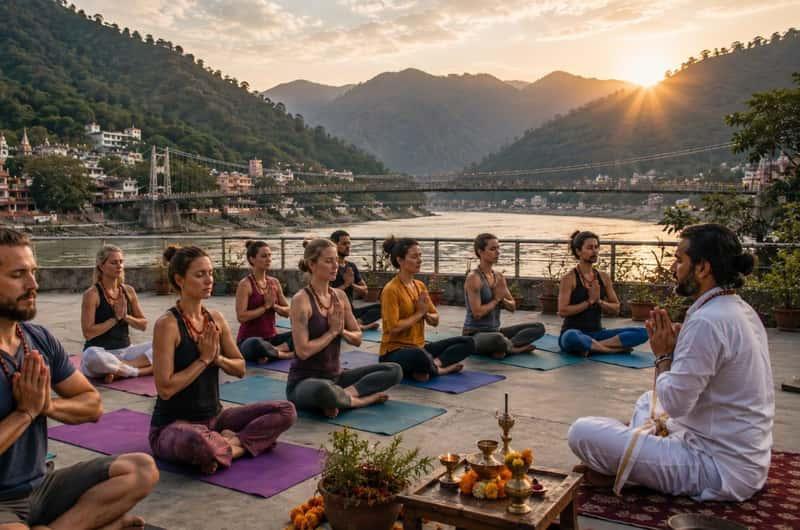
- Yoga in Rishikesh — how to choose
- The Ganga Aarti in Rishikesh and in Varanasi
- The rules: a vegetarian town, no alcohol, dress
- When to go to Rishikesh
- What the 16-day trip looks like
- Sources
- Frequently asked questions
Rishikesh sits in the state of Uttarakhand, at the point where the Ganges leaves the narrow Himalayan valleys before reaching the plains at nearby Haridwar. For centuries it has been a town of pilgrims and ascetics; since the 1960s it has also drawn people from all over the world who want to practise yoga where it has been practised for generations. This guide answers the questions we hear most often: what you actually do there, how to choose where to practise, whether you need to “know yoga” already, and when to go.
The short answer
Rishikesh rewards a slow, longer stay, not a sightseeing sprint. You get the most from two weeks in one ashram: practice morning and evening, lectures, meals at set times, and in your free hours a walk by the Ganges, the bridges, the Beatles Ashram and the evening Ganga Aarti. No previous yoga experience is needed. The most pleasant weather runs from October to April; July and August are the height of the monsoon.
Why Rishikesh: the Ganges, tradition and the Beatles
The town is known as the “gateway to the Garhwal Himalayas” — the roads to the holy sites higher in the mountains start here. Ashrams, temples and ghats line the river, and yoga, meditation and the study of texts are part of daily life, not a show for visitors. Since 1999 the International Yoga Festival, hosted by Parmarth Niketan ashram, has taken place here at the beginning of March; more than anything, it fixed the nickname “yoga capital of the world”.
In the West, Rishikesh was made famous by the Beatles. In February 1968 they came for a Transcendental Meditation course at the ashram of Maharishi Mahesh Yogi. Ringo Starr left after ten days, Paul McCartney in March, John Lennon and George Harrison in April — yet the stay was the band’s most productive songwriting period: most of the songs on the “White Album” were written here.
What to see in Rishikesh
- Ram Jhula — a pedestrian suspension bridge (built in 1986) linking the two ashram-lined banks.
- Lakshman Jhula and Bajrang Setu — the older bridge, completed in 1929, is the town’s symbol, but it was closed in 2019 for safety reasons. A new bridge, Bajrang Setu, with glass sections in the walkway, has been built beside it. Access rules for the new bridge have been changing, so check on the spot.
- Triveni Ghat — the largest ghat in town, where pilgrims bathe in the Ganges and the Ganga Aarti is performed at dusk.
- Parmarth Niketan — a large ashram right on the river, with an evening ceremony on the steps of its ghat. The yoga festival is held here.
- The Beatles Ashram (Chaurasi Kutia) — the ruins of the Maharishi’s former ashram, abandoned in the 1990s and taken over by the forest department. It lies within the Rajaji Tiger Reserve and was opened to visitors in December 2015. Today it is forest, dome-shaped concrete meditation huts and walls covered in murals. Check current opening hours and the fee at the gate.
Beyond that: riverside tea houses, bazaars selling mala beads and textiles, and for the adventurous, rafting on the Ganges — outside the monsoon season, when it is suspended.
Yoga in Rishikesh — how to choose
There is a huge amount on offer, and the options differ less in yoga style than in the kind of stay. Three basic choices:
| Format | What a day looks like | Rules | Who it suits |
|---|---|---|---|
| Ashram | A fixed schedule from dawn: meditation, asana, lecture, pranayama, evening practice, satsang | Vegetarian meals at set times, quiet in the evening, no alcohol | those who want to immerse themselves in the rhythm and the tradition |
| Yoga school | Drop-in classes or courses, including teacher trainings (most often 200 hours) | You stay elsewhere and plan your own day | practitioners who know what they are looking for |
| Retreat | A few days to a few weeks, with a programme set by the leader | Depends on the organiser; usually more comfortable rooms | those who want a rest with yoga in the background |
Teacher trainings are often advertised as meeting the Yoga Alliance standard; if that matters to you, check the school in that organisation’s online directory.
Do you need experience and fitness?
No. In good ashrams the morning classes are taught so that beginners and long-time practitioners can work side by side, each within their own range. What you do need to prepare for is early rising (in our programme the wake-up is at 5:00) and the fact that two asana sessions a day for twelve days is real effort. If you have back, joint or blood-pressure problems, tell your teacher on day one, and talk to your doctor before you travel.
Ayurveda — what makes sense and what to watch out for
Rishikesh is full of Ayurveda clinics — India’s traditional system of medicine. An oil massage is simply a pleasant way to relax after practice. Be careful, though, with Ayurvedic preparations taken by mouth: US health agencies (NCCIH and the FDA) warn that some of them contain lead, mercury or arsenic at levels that can be toxic. Do not stop prescribed medication in favour of a “cure”, do not buy products without a listed composition, and tell your doctor if you take anything. A yoga trip is rest and practice, not treatment.
Two weeks in an ashram without organising everything yourself: Rishikesh: A Journey to the Source of Yoga — 16 days, including 12 days of practice at an ashram with full board, transfers from Delhi and 24/7 English-speaking support. Available year-round, from €700.
Send me the programmeThe Ganga Aarti in Rishikesh and in Varanasi
The Ganga Aarti is an offering of fire to the river: lamps, chanting, bells and flowers set afloat on the water. In Rishikesh it is held every day at dusk in two main places — at Triveni Ghat (the larger, more “town” ceremony) and at Parmarth Niketan, where the ashram’s students sing and the mood is more focused. It is free and open to everyone. The time shifts with the season, so ask at your ashram.
In Varanasi the same ceremony is bigger and more theatrical, with crowds on the steps and boats on the river. In Rishikesh the Ganges is fast, green and mountain-fed, and the ceremony is more intimate. Many people feel both are worth seeing; if you are thinking of a wider journey to India’s sacred places, have a look at pilgrimages to India.

The rules: a vegetarian town, no alcohol, dress
- Meat and alcohol. Rishikesh is a vegetarian, alcohol-free town — their sale is banned within the town limits. The vegetarian food, on the other hand, is excellent; how to eat safely is covered in food in India.
- Dress. Shoulders and knees covered in temples, ashrams and on the ghats. Yoga clothes are for class, not for walking around town.
- Shoes. Leave them outside temples and practice halls.
- Ashram rules. Usually fixed meal times, silence after evening meditation, sometimes a curfew. It is part of the experience, not a hardship imposed on guests.
- Bathing in the Ganges. The current is strong even where the water looks calm. Go in only at the ghats, by the safety chains, and no deeper than your knees.
If you are travelling alone as a woman, you will find practical advice in India for solo women.
When to go to Rishikesh
October to April is the most pleasant time: after the monsoon the air is clear and the days warm, while in December and January the mornings can be chilly — a fleece is useful in an unheated ashram. The yoga festival takes place in early March, and Holi often falls in March too; what Indian festivals are like is covered in our guide to Diwali and Holi. From May it gets hot, and July and August are the peak of the monsoon: downpours, high water and rafting suspended. For ashram practice alone this is no obstacle — it is quieter, with fewer people.
What the 16-day trip looks like
Our programme Rishikesh: A Journey to the Source of Yoga is an individual journey for one or two travellers, available year-round:
- Day 1 — arrival in Delhi, transfer to the hotel, rest.
- Day 2 — private transfer to Rishikesh, check-in at the ashram, first meditation.
- Days 3–14 — 12 days of practice: morning meditation and yoga, a yoga-philosophy lecture, pranayama, a Q&A session, evening yoga and meditation, satsang after dinner. Full board at the ashram.
- Day 15 — return to Delhi.
- Day 16 — airport transfer.
Price: from €700 per person in a double room (minimum two travellers) or €1,150 in a single room. It covers transfers, transport Delhi–Rishikesh–Delhi, the yoga programme, full board at the ashram and three nights in a Delhi hotel with breakfast. Flights, visa and insurance are not included — how to choose a connection is covered in flights to India. The trip is organised and operated by the Indian tour operator Abyss Tours; we coordinate and stay in touch throughout.
Sources
- Wikipedia — Rishikesh: location, “gateway to the Garhwal Himalayas”, yoga festival since 1999, vegetarian and alcohol-free town
- Wikipedia — The Beatles in India: February–April 1968, the meditation course, White Album songs
- Wikipedia — Beatles Ashram: abandonment, forest department, opened to visitors in December 2015
- The Tribune — closure of the Lakshman Jhula bridge (2019)
- India TV News — Bajrang Setu, the new bridge replacing Lakshman Jhula
- Wikipedia — Ram Jhula (1986)
- Wikipedia — Triveni Ghat and the evening Ganga Aarti
- Utsav (Ministry of Tourism, India) — International Yoga Festival at Parmarth Niketan
- The Tribune — rafting suspended during the monsoon
- NCCIH — Ayurvedic Medicine: safety of preparations and heavy metals
- FDA — warning about heavy-metal poisoning from Ayurvedic products
- Yoga Alliance — directory of registered yoga schools
Frequently asked questions
Do I need yoga experience for a yoga trip to Rishikesh?
No. In ashrams beginners and advanced practitioners practise together, each within their own range. You do need to be ready for early mornings and two asana sessions a day. If you have back, joint or blood-pressure problems, discuss the trip with your doctor and tell your teacher.
What is the difference between an ashram and a yoga school?
In an ashram you live on site and follow a fixed schedule: meditation at dawn, yoga, lectures, vegetarian meals at set times, quiet in the evening. At a school you attend classes or a course and plan the rest of your day yourself. A retreat is usually a programme of a few days with more comfortable rooms.
Where can I see the Ganga Aarti in Rishikesh?
Every day at dusk at Triveni Ghat, where the ceremony is largest, and at Parmarth Niketan ashram, where it is more focused. It is free and open to everyone. The time changes with the season.
Can you drink alcohol and eat meat in Rishikesh?
Not within the town limits — Rishikesh is a vegetarian town and the sale of meat and alcohol is banned there. It is a Hindu holy town. The vegetarian food is very good, and ashram meals are vegetarian anyway.
When is the best time to go to Rishikesh?
October to April, when it is warm and dry; in December and January the mornings can be chilly. The International Yoga Festival takes place in early March. July and August are the peak of the monsoon, with downpours and rafting suspended, though this does not get in the way of ashram practice.
How much does the 16-day yoga trip to Rishikesh cost?
Our programme costs from €700 per person in a double room (minimum two travellers) or €1,150 in a single room. The price covers transfers, transport from Delhi, 12 days of practice at an ashram with full board and three nights in a Delhi hotel. Flights, visa and insurance are extra.