The Himalayas and the Taj Mahal in one holiday sounds like two separate trips — and in a way it is. Nepal and India are neighbours, but they differ in pace, landscape and even time zone. That is exactly why they complement each other so well: after a few days of mountain air and quiet Buddhist shrines, India's bazaars feel different. This guide will help you decide whether to combine the two, how many days to allow and which formalities to sort out.
The short answer
Combining them makes sense if you have at least two weeks, ideally three. Our Nepal & India programme runs for 20 days: a week in Nepal (Kathmandu, Pokhara, a short trek below Annapurna) and just under two weeks in India (Khajuraho, Orchha, Agra, Jaipur, Delhi). You fly between the two countries — Delhi to Kathmandu takes about 1.5–2 hours. You need two visas: an Indian one arranged before you travel, and a Nepali one, which most visitors get on arrival at Kathmandu airport.
What to see in Nepal
Kathmandu and the valley
The capital sits in a basin at around 1,300 m above sea level. The Kathmandu Valley has been on the UNESCO World Heritage List since 1979 as a single site made up of seven monument zones: three royal squares (the Durbar Squares of Kathmandu, Patan and Bhaktapur), two Buddhist stupas (Swayambhu and Boudhanath) and two Hindu temple complexes (Pashupati and Changu Narayan).
- Boudhanath — the largest stupa in Nepal. Pilgrims walk around it clockwise, turning the prayer wheels.
- Swayambhunath — a stupa on a hilltop west of the centre, the oldest Buddhist monument in the valley, known as the "Monkey Temple". The hill gives a view over the city.
- Pashupatinath — a Hindu temple complex on the Bagmati River and a place of pilgrimage.
- Kathmandu Durbar Square — the old royal square with its pagodas and the Kumari Ghar, home of the Kumari, the "living goddess".

Pokhara and Phewa Lake
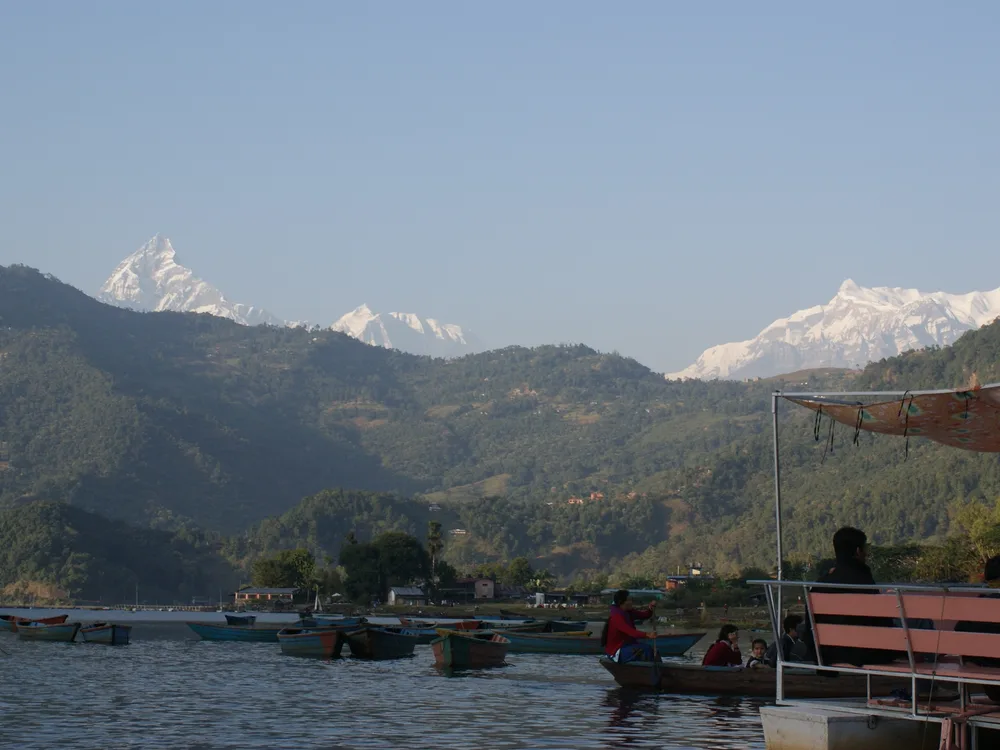
Pokhara lies lower than Kathmandu, at about 820 m, on the shore of Phewa Lake. From Kathmandu it is roughly 200 km by the Prithvi Highway along the Trisuli valley — 6 to 8 hours depending on traffic and road conditions. On a clear day the Annapurna massif and Machapuchare (6,993 m), the "Fishtail", rise above the town. The peak is considered sacred and has never been officially climbed — Nepal does not issue permits for it.
Pokhara is not about ticking things off: a boat on the lake, a walk up to the Peace Pagoda on the hill, coffee with a mountain view. For the adventurous, a paraglider flight over the valley.
The Himalayas without a serious trek
You do not have to walk to Everest to see the Himalayas up close. Our programme includes one short trek: from Kande up to Australian Camp at 2,060 m, through rhododendron forest, with a night in a mountain lodge and sunrise over Annapurna. The next day you descend through the village of Dhampus to Phedi. It is a walk for ordinary fitness, though steep in places — good shoes and trekking poles help.
Honestly about altitude: altitude sickness usually appears above about 2,500 m, so Kathmandu, Pokhara and Australian Camp are all below that line. If you have heart or lung conditions or blood-pressure problems, talk to your doctor — ideally a travel-medicine specialist — before you go.
How the combined route works
The programme is modular: you can take the whole trip or just one country.
| Option | Days | Route | From / person |
|---|---|---|---|
| Nepal + India | 20 days / 19 nights | Delhi, Kathmandu, Pokhara, Australian Camp, Khajuraho, Orchha, Agra, Jaipur, Delhi | €2,250 |
| Nepal | 8 days | Kathmandu, Pokhara, trek to Australian Camp | €950 |
| India | 12 days | Khajuraho, Orchha, Agra, Jaipur, Delhi | €1,150 |
Prices per person sharing a double room, group of min. 10. The full route includes the Delhi–Kathmandu–Delhi and Delhi–Khajuraho flights; the Nepal module does not include the Delhi–Kathmandu–Delhi flights. International flights, visas, insurance and entrance fees are extra.
The full route starts with arrival in Delhi, and the next day you fly to Kathmandu. After a week in Nepal you return to Delhi and head south: the temples of Khajuraho, Orchha on the Betwa River, the Taj Mahal at sunrise, Jaipur, and finally a few days in Delhi. More on the Indian part: the Golden Triangle: what to see and how to visit the Taj Mahal.
The Himalayas and the Taj Mahal in one trip: Nepal & India — 20 days or an 8- or 12-day module, with a tour leader for groups of 10 or more, group departure in September/October. Smaller groups get an individual quote.
Send me the programmeVisas: India's e-visa and Nepal's visa
India. Most nationalities need a visa arranged before departure — see do you need a visa for India. On a combined route the number of entries matters, because you enter India twice. The 30-day e-Tourist visa allows two entries and is valid for 30 days from your first arrival — the 20-day programme fits within it. If you plan a longer stay, choose the one-year or five-year e-visa, which allow multiple entries. Remember the e-Arrival Card too: it is completed within 72 hours before arriving in India. The requirement applies to entering India, so on a combined route complete it again before the flight from Kathmandu to Delhi.
Nepal. Most visitors can get a tourist visa on arrival at Kathmandu airport. You fill in the form at a kiosk at the airport or online in advance — the barcode receipt is valid for 15 days. The visa allows multiple entries and is issued for 15, 30 or 90 days; the fee is paid in US dollars (in 2026: USD 30, 50 and 125). Citizens of a short list of countries are not eligible for a visa on arrival and must apply in advance through a Nepali mission — check the Department of Immigration website, where current fees are also published.
Your passport should be valid for at least six months beyond the end of the trip.
The best season for both countries
The Nepal Tourism Board points to two best periods: autumn (September–November), with the clearest skies after the monsoon, and spring (March–May), when the rhododendrons bloom. On the plains of India the best months are October to March — more in the best time to visit India.
- October–November — the best window for both: the mountains are clear and northern India becomes pleasant.
- February–March — still good in India, spring arriving in Nepal; mountain views are often hazier than in autumn.
- June–August — monsoon on both sides of the border. Not the time for this route.
Autumn is also the season of major festivals — see Diwali and Holi.
Money, time, fitness — how Nepal differs from India
- Currency. Nepal uses the Nepalese rupee (NPR), pegged to the Indian rupee at 1.6 NPR to 1 INR. Do not count on paying in Indian rupees, though — the rules on Indian banknotes in Nepal have changed over the years, so change money locally. Money in India: money in India.
- Time. Nepal is on UTC+5:45 — set your watch 15 minutes ahead of India.
- Pace. Kathmandu is dense and noisy, but Pokhara and the mountains move at a completely different rhythm from Delhi or Agra.
- Fitness. India means a lot of walking around monuments; Nepal adds an uphill walk. Ordinary fitness is enough.
- Baggage. On the flights to and from Kathmandu the limit is 20 kg checked plus 7 kg hand luggage. How to get to Delhi in the first place: flights to India.
Sources
- UNESCO World Heritage Centre — Kathmandu Valley (seven monument zones)
- Encyclopaedia Britannica — Kathmandu (elevation)
- Wikipedia — Pokhara (elevation)
- Wikipedia — Machapuchare (height, climbing ban)
- Magical Nepal — Australian Camp and Dhampus (altitude, route)
- Nepalpin — Prithvi Highway, Kathmandu–Pokhara (distance, time)
- Department of Immigration, Nepal — tourist visa and fees
- Department of Immigration, Nepal — online form and visa on arrival
- Immigration Office, Tribhuvan Airport — nationals not eligible for a visa on arrival
- Indian Visa Online — e-Tourist visa types and number of entries
- Embassy of India — e-Arrival Card
- Nepal Tourism Board — climate and best seasons
- NHS — altitude sickness (above 2,500 m)
- Wikipedia — Nepalese rupee (peg to the Indian rupee)
- Wikipedia — Nepal Standard Time, UTC+5:45
Frequently asked questions
How many days do you need for Nepal and India in one trip?
A sensible minimum is two weeks; three is comfortable. Our Nepal & India programme runs for 20 days: a week in Nepal and just under two weeks in India. With only 10–12 days, it is better to choose one country.
How do you get from India to Nepal?
The easiest way is to fly: Delhi to Kathmandu takes about 1.5–2 hours. On the full Nepal & India programme the Delhi–Kathmandu–Delhi flights are included; the Nepal module does not include them.
Which Indian visa do I need if I visit Nepal on the way?
One that allows you to enter India twice. The 30-day e-Tourist visa gives two entries and is valid for 30 days from your first arrival, which covers the 20-day programme. For a longer stay, choose the one-year or five-year e-visa, which allow multiple entries.
Can I get a Nepal visa on arrival?
Most nationalities can, at Kathmandu airport; the form can be filled in online in advance or at a kiosk on arrival. The visa allows multiple entries and is issued for 15, 30 or 90 days, paid in US dollars. A few nationalities must apply in advance — check the Department of Immigration website before you fly.
Do I have to trek in Nepal?
Our programme includes one short trek to Australian Camp at 2,060 m, with a night in a mountain lodge. It is a walk for ordinary fitness, with no climbing. The rest of the time is sightseeing in Kathmandu and relaxing in Pokhara.
When is the best time to visit Nepal and India?
The best window for both is October and November, when the mountains are clear after the monsoon and the plains of India are pleasant. February and March are the second option. Our group departure for this programme is in September/October.